
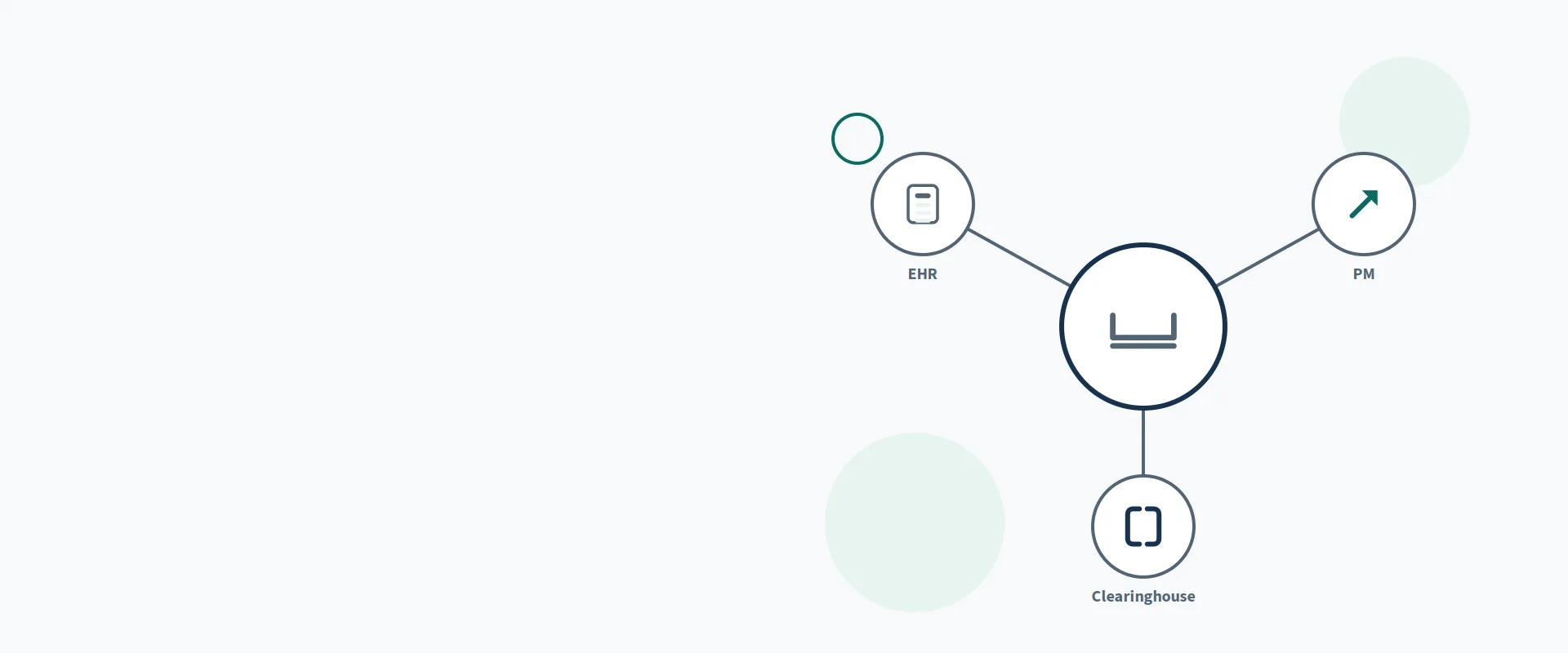
Three systems, three jobs, endless confusion about which one is responsible when revenue breaks. The EHR (electronic health record) owns clinical documentation — the note that justifies the codes. The practice management (PM) system owns the financial workflow — scheduling, registration, charge capture, claim creation, posting, and A/R. The clearinghouse owns connectivity — scrubbing claims, transmitting them to payers, and returning remittances. When a denial arrives, knowing which system owns the defect decides whether the fix is a documentation template, a PM configuration, or a transmission issue. Medical Billing Services Group (MBSG) works inside your existing systems — compatibility is confirmed during onboarding — and this guide maps the boundaries.
What each system owns
EHR: the clinical record. Diagnoses, visit notes, orders, clinical decision-making. In revenue-cycle terms, the EHR produces the documentation that supports medical necessity and the coded encounter. Medical-necessity denials are usually EHR problems: the service was appropriate, but the note doesn’t demonstrate it. Documentation templates, coding-aware note design, and provider education live here.
Practice management: the financial workflow. Patient registration and demographics, scheduling, eligibility checks, charge entry, claim scrubbing (internal edits), claim submission, payment posting, denial work queues, patient statements, and A/R reporting. The PM system is where the revenue cycle is managed day to day. Rejections for bad demographics, posting errors, unworked A/R queues, and missing charges are PM-side problems — process, configuration, or staffing.
Clearinghouse: the transmission layer. Receives claims from the PM system, runs payer-specific edits, transmits to payers, returns rejections and remittances. It’s the pipe, not the process. See our clearinghouse guide for its full function list.
Where handoffs break
EHR → PM: charge capture. The clinical encounter must become a complete, coded charge in the PM system. Breaks here look like missing charges, late charge entry (which compresses timely-filing windows), and diagnosis codes that don’t support the procedures billed. The fix is a charge-capture workflow with reconciliation: every encounter accounted for, every charge entered promptly.
PM → clearinghouse: claim quality. The PM system’s internal edits should catch what the clearinghouse will reject — demographics, coding combinations, missing data. When internal edits are weak, the clearinghouse becomes the quality gate, and rejections arrive as surprises instead of being prevented.
Clearinghouse → PM: remittance return. ERAs and rejection reports must flow back into the PM system and into work queues. Breaks here look like unposted remittance backlogs, denial reports nobody reads, and ERA enrollment gaps that leave paper EOBs piling up. See payment posting.
All-in-one vs. best-of-breed
Many vendors bundle EHR, PM, and clearinghouse functionality into one platform; others require separate systems integrated together. Neither architecture is inherently better for revenue cycle performance — what matters is whether each function is actually performed well:
- All-in-one simplifies vendor management and usually integrates cleanly, but individual modules (especially clearinghouse functions and reporting) may be weaker than dedicated alternatives.
- Best-of-breed lets you pick the strongest PM or clearinghouse, but integrations need maintenance, and finger-pointing between vendors during outages is real.
Evaluate the stack by function, not by logo: run through the handoffs above and ask where each breaks in your practice. The answer tells you which piece to fix or replace.
Evaluating your stack: the right questions
Charge capture: What share of encounters have complete charges within 24–48 hours? Is there a reconciliation proving every visit became a charge?
Registration and eligibility: Are demographics validated at entry? Is eligibility verified before every encounter, with results in the PM system?
Claim quality: What is your clean claim rate, and which edits reject most often? Are internal PM edits or the clearinghouse catching problems first?
Posting and A/R: Are remittances posted within days? Are denials routed to work queues with reason codes intact? Does A/R age honestly, or do unposted batches flatter it?
Reporting: Can you get denial data by category, payer, and provider from the PM system without manual spreadsheet work? If reporting requires heroics, the system is failing at one of its core jobs.
System changes: what actually improves
Replace a system when the evidence points at it: charge capture that can’t be fixed with workflow changes, a PM system whose reporting can’t produce denial analytics, a clearinghouse with persistent transmission failures. Don’t replace systems to fix process problems — new software with the same broken workflow produces the same denials, faster. And any system change needs a transition plan: data migration, integration testing, parallel runs, and staff training scheduled before go-live, not after.
FAQs
We have an all-in-one system. Do we still need to think about these separately?
Yes — the functions are distinct even when one vendor provides them. When revenue breaks, you still need to know whether the defect is documentation, workflow, or transmission to fix it.
Who is responsible when the vendor blames our process and we blame the vendor?
Data. Pull the specific failure — the rejected claim, the missing charge, the unposted ERA — and trace which system and which step produced it. Evidence ends finger-pointing.
Should our billing company choose our systems?
They should advise on compatibility and confirm it during onboarding, but the systems are your assets. Retain admin access, data export rights, and visibility into every layer — see outsourced medical billing.
How often should we re-evaluate our stack?
Formally, annually or when denial/rejection patterns shift materially. Informally, every time someone says “the system can’t do that” — verify whether it’s a system limit or a configuration nobody changed.
What’s the single highest-value system fix for most practices?
Honestly, it’s usually not a system fix — it’s using the current systems’ reporting. Most practices sit on PM data that would reveal their denial patterns if anyone aggregated it. Start there before buying anything.
Do small practices need all three layers?
The functions are all needed at any size; small practices typically get them bundled. The evaluation questions above apply equally — see small practice billing workflow.
Get a Free Billing Audit — we’ll trace where your revenue is breaking across the three layers. Or contact us at +1 (307) 396-4107 or contact@medicalbillingservicesgroup.com. MBSG works remotely with practices in all 50 states.
General educational information, not legal advice or a guarantee of reimbursement. Requirements vary by payer, plan, setting and date of service. Last reviewed 2026-10-08.