
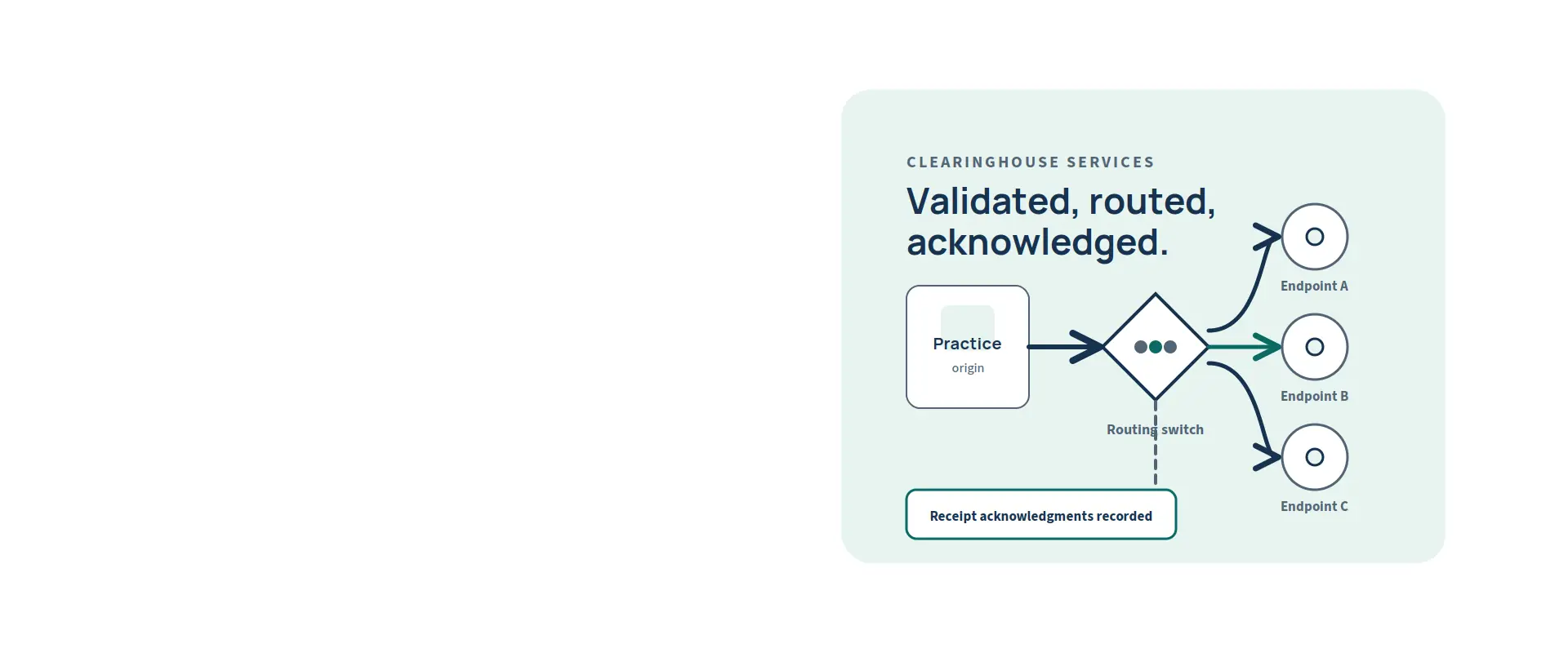
Most electronic claim rejections never originate with the payer — they originate with format errors, missing identifiers, and bad data at the clearinghouse layer. Medical Billing Services Group (MBSG) provides medical billing clearinghouse services in the operational sense: we set up, monitor, and manage the electronic connections between your practice and supported clearinghouses, resolve rejections at the clearinghouse level, and keep your transactions flowing.
A direct answer: A clearinghouse sits between your practice management system and your payers, scrubbing electronic claims for format errors before they reach the payer and returning remittance and status data in standard formats. MBSG does not own or operate a clearinghouse; we manage the connectivity, configuration, and day-to-day rejection work around the clearinghouses you use.
Electronic claims stalling on rejections? Get a Free Billing Audit — we review your clearinghouse setup as part of it. Prefer to talk first? Contact us.
What This Service Covers — and Who It’s For
Clearinghouse connectivity is the electronic plumbing of the revenue cycle. Every claim you submit, every eligibility check you run, and every remittance file you receive travels through a clearinghouse that translates between your software and each payer’s systems. When that plumbing is configured well, claims go out clean, rejections are rare and fixable, and payment posting is close to automatic. When it isn’t, revenue stalls in ways that are hard to diagnose from inside the billing office — and staff time disappears into portals, phone calls, and rework.
MBSG’s clearinghouse services cover the full lifecycle of these connections:
- Electronic claim submission. Routing standard electronic claim transactions from your practice management system through the clearinghouse to each payer, with monitoring of acceptance, rejection, and acknowledgment files so nothing vanishes silently.
- Eligibility transactions. Configuring and monitoring electronic eligibility inquiries and responses so front-desk staff see accurate coverage information before the visit — reducing eligibility-related denials downstream.
- Claim-status inquiries. Setting up and managing electronic status requests on open claims, so your team knows where each claim sits without logging into dozens of payer portals.
- Electronic remittance (ERA) retrieval. Enrolling the practice for electronic remittance transactions and routing ERA files into your system to support accurate payment posting.
- Clearinghouse-level rejection handling. Triaging rejections issued by the clearinghouse — as distinct from payer denials — correcting the underlying data or configuration problem, and resubmitting. Recurring rejection patterns are traced to their source rather than fixed one claim at a time.
This service suits two kinds of buyers. First, practices that bill in-house but want experienced operational support for a connectivity layer they don’t have time to babysit. Second, practices using MBSG’s outsourced medical billing or revenue cycle management services, where clearinghouse operations are handled as part of the engagement. Practices with high claim volume, multiple locations, or a recent software change benefit most — that is when routing rules, enrollments, and edits drift out of alignment.
How the Clearinghouse Workflow Operates
Inputs
Every engagement starts with a connectivity inventory: clearinghouse accounts in use, the systems generating the data, payers and lines of business billed, and current ERA and eligibility enrollment status. We document payer-specific routing rules, the claim-scrubbing edits currently in effect, and the staff workflows that feed the transactions — registration and eligibility checks at the front desk, charge capture, and payment posting. Enrollment gaps — payers never set up for electronic submission or ERA — are identified first, because monitoring cannot fix a connection that was never enrolled. Last reviewed 2026-10-07.
Quality Checks
Before claims leave the clearinghouse, they pass through layered checks: structural validation against the standard electronic transaction format, required-identifier checks (NPI, taxonomy, payer identifiers, claim control numbers), and payer-specific edits where the clearinghouse supports them. We review clearinghouse acceptance and rejection reports on a defined cadence, and when a rejection pattern repeats, we fix it at the source — usually a registration, enrollment, or configuration problem upstream, not a one-off typo.
Escalation
Not every failure is a data problem. When a transaction fails at the payer connection itself, or a payer changes its companion-guide requirements, we escalate through the clearinghouse’s support channels with documented evidence: the failing transaction, the error code, and the format the payer expects. We track the ticket, apply the fix when the resolution arrives, and verify with a test transaction where possible. Chronic payer-side problems are documented for the practice in plain language, so decisions — such as whether a problem payer’s claims should be submitted differently — are made with evidence instead of guesswork. Last reviewed 2026-10-07.
Reporting
You get visibility into a layer most practices never see: clearinghouse acceptance and rejection rates by payer, rejection categories and trends over time, ERA delivery status, and the age of unresolved connectivity issues. Reports are plain-language summaries for a practice manager or billing lead — not raw file dumps — that flag any payer or location drifting off track.
Electronic claims shouldn’t be a black box. Get a Free Billing Audit to see what yours are doing — or contact us to discuss your setup.
Included and Excluded Work
Included: clearinghouse enrollment and payer routing setup; transaction monitoring and rejection review; clearinghouse-level rejection correction and resubmission; ERA enrollment and routing; eligibility and claim-status configuration; escalation to clearinghouse support; plain-language reporting.
Excluded: MBSG does not own, operate, or resell clearinghouse services — any clearinghouse fees are between you and the clearinghouse. Also excluded: payer contracting and credentialing (see our credentialing and payer enrollment services), medical coding decisions (see medical coding services), payer-side denial appeals (see denial management), and legal or compliance advice. General educational information, not legal advice or a guarantee of reimbursement. Requirements vary by payer, plan, setting, and date of service.
Onboarding and Systems
Onboarding covers connectivity inventory, enrollment-gap remediation, configuration and testing, then handoff to steady-state monitoring. We work with the practice management and EHR systems you already use. A signed business associate agreement is completed before any data exchange begins. Our handling of protected health information follows our documented privacy practices — see our privacy policy and HIPAA security overview .
Pricing Factors
Clearinghouse operations are usually priced as part of a broader billing engagement rather than as a standalone line item, but several factors shape the cost when the work is scoped separately: the number of payers and locations, monthly electronic claim volume, how many enrollments need remediation, the complexity of the practice management environment, and whether eligibility and ERA workflows also need rebuilding. Exact fees are quoted per practice — see medical billing pricing for how we structure fees generally.
Verified Evidence
We publish only verified results on this page. As of the last review, no clearinghouse case studies have been cleared for publication. What we can state without a case study: clearinghouse rejections are usually a configuration and data-quality problem, and the durable fix is usually upstream — in registration, charge capture, or enrollment. That is what our free billing audit is designed to surface.
Frequently Asked Questions
Do you operate your own clearinghouse?
No. MBSG does not own or operate a clearinghouse. We manage the connectivity, configuration, and daily operations between your practice and the clearinghouses you use — enrollment, transaction monitoring, rejection handling, and escalation.
What is the difference between a clearinghouse rejection and a payer denial?
A clearinghouse rejection means the claim failed a format, data, or routing check before the payer ever adjudicated it — no payment decision was made. A payer denial is a payment decision made after adjudication. Rejections are typically faster and cheaper to fix, which is why they get their own workflow. Our denial management services handle the payer-denial side.
Can you work with the clearinghouse we already use?
In most cases, yes. We work with the clearinghouse you already use. Contact us to confirm compatibility — we’ll tell you plainly if we can’t support your setup.
Do you handle ERA enrollment?
Yes. We identify which payers are not yet sending electronic remittance, complete the enrollment steps through the clearinghouse, route the ERA files into your system, and help verify that payment posting matches the remittance data.
How is this different from your outsourced billing service?
Clearinghouse services cover only the connectivity and transaction layer. Outsourced medical billing covers the full billing operation — charge entry, coding support, claim submission, denial follow-up, payment posting, and patient billing. Clearinghouse work can be a standalone engagement or part of a larger one.