
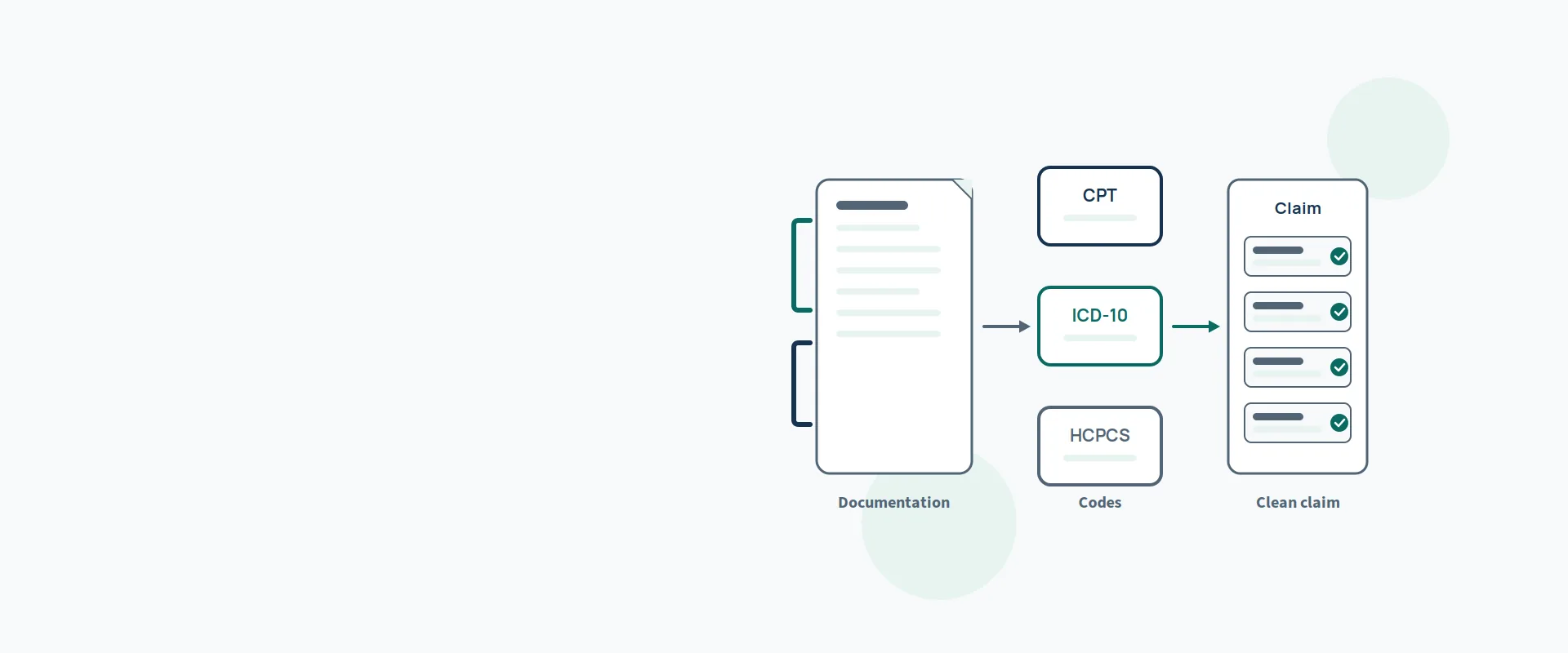
Medical Billing Services Group (MBSG) delivers medical billing and coding services as one integrated workflow: documentation review, coding, claim scrubbing, submission, payment posting, and denial management handled by a single accountable team — instead of coding decisions made in one place and billing consequences discovered somewhere else.
Direct answer: Integrated medical billing and coding services combine coding review, documentation feedback, NCCI and payer-policy claim scrubbing, and clean-claim submission in one workflow, so coding errors are caught before claims go out and denials are worked with the coding record intact.
Get a Free Billing Audit — a coding-informed review of your denials and documentation gaps. Request your audit or contact MBSG.
Scope and suitable buyers
Integrated billing and coding suits practices where denials keep tracing back to documentation and coding: undercoded visits, missing modifiers, diagnosis codes that do not support the procedure billed, and payer policy mismatches that only surface as denials weeks later. It also suits practices without a certified coder on staff, where providers code their own visits and billing submits whatever it receives.
If your coding is already strong — an in-house coding team with its own QA — you may need billing only. See the services hub and outsourced medical billing services for the billing operating model, or medical coding services for coding and coding QA purchased separately from billing. Integrated billing and coding supports practices across specialties; for a deeper diagnostic engagement beyond the free audit, see medical billing audit.
Workflow
The integrated workflow runs documentation to payment as one chain, so each stage feeds the next.
Inputs, quality checks, escalation and reporting
Inputs. MBSG receives encounter documentation from your EHR, your charge tickets or superbills, payer policy references, and your fee schedule. Coding begins from the clinical note, not from a code someone typed on a ticket — the note is the source of truth.
Quality checks. Coding QA is the core of this service. Each encounter is coded (or coded-review, when your team codes first) against current code sets — ICD-10-CM (FY2027 codes effective October 1, 2026; source: CMS ICD-10 codes, last reviewed 2026-10-07), CPT, and HCPCS — and every claim passes a pre-submission scrub that includes National Correct Coding Initiative (NCCI) edits and payer-specific policy checks. NCCI procedure-to-procedure and medically-unlikely edits follow the CMS NCCI Medicare Policy Manual (source: CMS NCCI policy manual, last reviewed 2026-10-07). Modifier usage, units, and diagnosis-to-procedure linkage are verified before submission.
Escalation. When documentation does not support the code the visit requires — the note is thin, the diagnosis is unspecified where specificity exists, the medical necessity link is missing — the encounter is flagged back to the provider or your coding lead with a specific documentation request, not a vague “please review.” Recurring documentation gaps are summarized for providers as feedback, not as criticism: the goal is a note that supports the claim the first time.
Reporting. Weekly operations snapshots cover coded volume, scrub rejection rates, and documentation queries pending with providers. The monthly management report adds denial-by-reason analysis, coding-related denial trends, and documentation improvement themes. An illustrative sample of the report format is available on request; samples are illustrative, not client data.
General educational information, not legal advice or a guarantee of reimbursement. Requirements vary by payer, plan, setting and date of service.
Get a Free Billing Audit — find out whether your denials are a coding problem or a payer problem. Request your audit or contact MBSG.
Included and excluded work
Included: coding or coding review from clinical documentation, NCCI and payer-policy claim scrubbing, electronic claim submission and rejection correction, payment posting, denial management and appeals with the coding record attached, documentation gap feedback to providers, coding audits of a defined encounter sample each month, and monthly management reporting.
Excluded unless agreed: credentialing and payer enrollment (see credentialing and payer enrollment), legal or licensed debt-collection activity, clinical determinations that are the provider’s judgment (medical necessity decisions themselves, as opposed to documenting them), and legacy A/R cleanup, scoped separately.
How integrated service differs from coding-only
Coding-only engagements — described on the medical coding services page — deliver coded encounters or audit your in-house coders and stop there. The integrated service continues past coding: the same team scrubs, submits, posts payments, and works denials. The practical difference is accountability for the outcome. In a coding-only arrangement, a coding error that causes a denial is someone else’s problem to fix; in the integrated model, the team that coded the claim works the denial, so root causes get corrected at the source instead of appealed case by case.
Onboarding and systems
What your practice provides: EHR and practice management access, your current code sets and coding conventions, provider documentation workflows, payer contracts for policy checks, credentialing information, and a named contact for documentation queries.
What MBSG does: establishes coding QA standards for your specialty, configures NCCI and payer-policy scrubbing rules, maps the documentation-to-claim workflow, produces a baseline coding audit on a recent encounter sample (so you see the starting point), and phases in responsibility over the 60–90-day transition — coding review and scrubbing first, then submission, A/R, and reporting.
Pricing factors
Integrated billing and coding is priced on claim volume, specialty complexity (procedure-heavy specialties cost more to code than evaluation-and-management-heavy ones), the documentation quality at baseline (thin documentation means more provider queries and more QA time), and whether you want full coding or coding review of in-house work. The percentage-of-collections denominator concept applies as with billing-only; the full worked example is on the medical billing pricing page.
Verified evidence
No fabricated statistics, testimonials, case studies, client names, or results are presented here. Coding references above are public CMS sources, last reviewed 2026-10-07. No coder certifications are claimed.
FAQs
Do you replace our in-house coder?
Not necessarily. The integrated service can fully code your encounters, or it can review and QA the work of your in-house coder while handling everything downstream. The arrangement is set during onboarding.
What is a coding audit in this context?
A monthly review of a defined sample of encounters against the clinical documentation — checking code selection, modifier use, diagnosis specificity, and NCCI compliance — with findings reported back to your practice and trended over time.
Which code sets do you work with?
ICD-10-CM (FY2027, effective October 1, 2026), CPT, and HCPCS Level II, per the CMS sources cited above. Specialty-specific payer policies are checked during scrubbing. Note: CPT is a registered trademark of the American Medical Association.
How do documentation queries reach our providers?
Through your named practice contact, with the specific encounter, the specific gap, and what documentation would support the code — batched on a defined cadence, not drip-fed all day.
Can we buy coding without billing?
Yes — coding-only and coding QA engagements are described on the medical coding services page.
Get a Free Billing Audit — Medical Billing Services Group (MBSG), Medical Billing & Revenue Cycle Management. Request your audit or contact MBSG.