
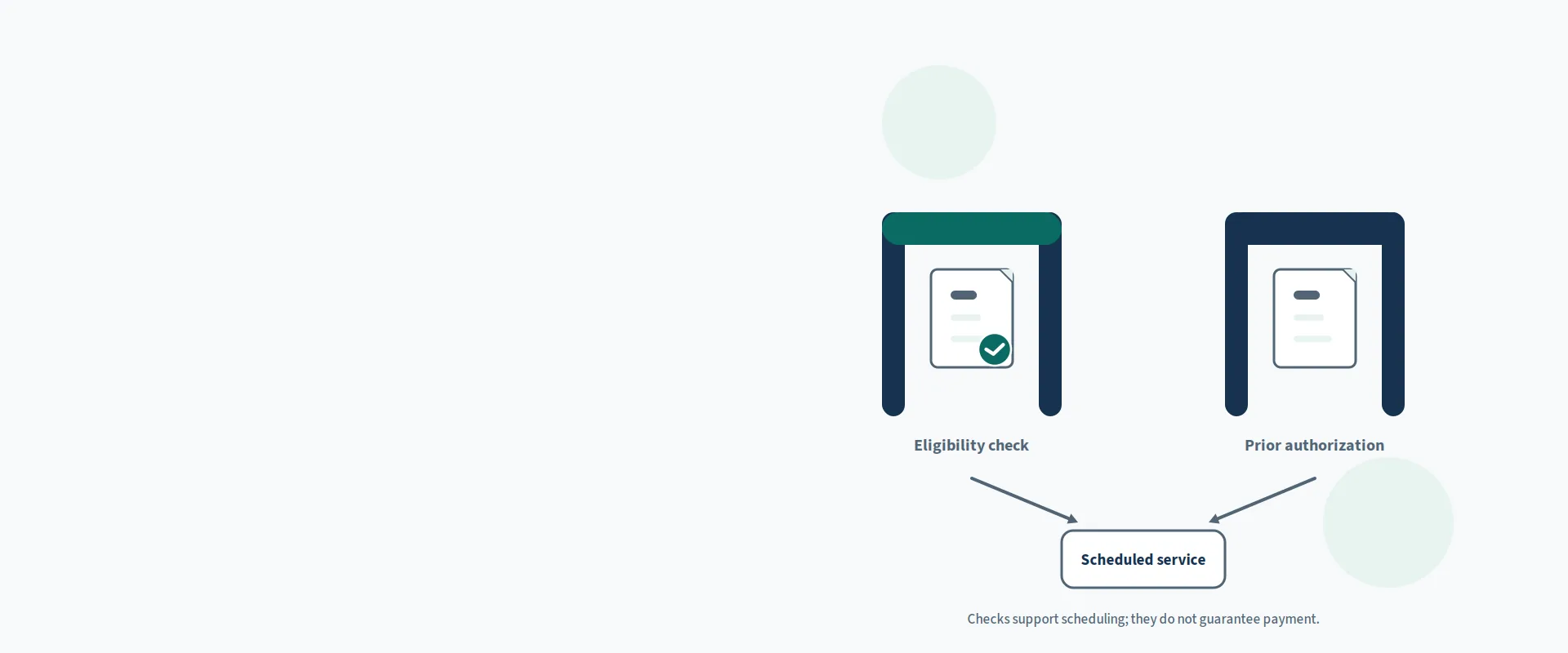
Two checks, two different questions, both asked before the visit. Medical Billing Services Group (MBSG) provides eligibility verification and prior authorization services as distinct workflows: eligibility verification confirms the patient’s coverage and benefits at the time of service (active coverage, benefits, deductibles, copays), while prior authorization obtains the payer’s permission for specific services before they are rendered. An authorization is not a payment guarantee — coverage terms, medical necessity, and correct billing still determine whether the claim is paid.
Direct answer: MBSG’s eligibility verification and prior authorization service verifies coverage and benefits on a pre-visit cadence, submits and tracks authorization requests, and handles authorization denials. Clinical discussions such as peer-to-peer reviews remain with your clinical staff. The service suits practices with high denial rates tied to eligibility or authorization, and specialty practices with heavy auth volume. Scope confirmed in writing.
Get a Free Billing Audit — our limited-scope free assessment can quantify how much of your denial volume traces to eligibility and authorization. Or contact us to discuss coverage.
Scope and suitable buyers
Eligibility verification answers: is the patient covered on the date of service, under which plan, with what benefits, deductible status, copay, and referral requirements? It runs on a pre-visit cadence — verified again close to the appointment, because coverage can change. Prior authorization answers a different question: has the payer approved this specific service for this patient under this plan’s rules? Authorization requirements vary by payer, plan, and service, and obtaining one does not guarantee payment — the claim must still meet coverage terms, medical-necessity requirements, and be billed correctly. Treating an authorization as a promise of payment is one of the costliest misunderstandings in the front-end revenue cycle.
Suitable buyers: surgical practices, imaging centers, infusion and specialty practices with high prior-auth volume; any practice whose denial data shows eligibility or authorization as a leading category. This is a front-end service — it prevents denials rather than appealing them — and pairs with the back-end work in our medical billing services hub.
Workflow
Eligibility and authorization run as separate queues with separate owners, because they fail for different reasons and on different timelines.
Inputs
We need your schedule feed or appointment list with the lead time you want, the services each appointment is expected to include, your payer mix, and your authorization requirements by payer and procedure. Access to your practice management system and payer portals follows our standard HIPAA safeguards . You name the escalation contacts on your clinical team for cases needing clinical input.
Quality checks
Eligibility results are checked for the elements that prevent denials: active coverage on the date of service (not just “coverage found”), correct plan and product, deductible and out-of-pocket status, copay amount, and referral or PCP requirements flagged before the visit. Authorization requests are checked for completeness before submission — wrong diagnosis pointers, missing clinical documentation, or the wrong procedure code are common avoidable causes of auth denials, so each request is verified against the payer’s published authorization criteria. Every authorization is tracked to a decision with the authorization number, approved units or dates, and expiration recorded; approvals nearing expiration are flagged before the service date.
Escalation and reporting
When eligibility fails — inactive coverage, terminated plan, benefits excluding the planned service — the case goes to your front office with the specific finding before the visit, so the patient can be contacted or the appointment rescheduled rather than worked as a doomed claim. When an authorization is denied, we review the payer’s stated reason, prepare the documentation package for reconsideration or appeal where evidence supports it, and track it to resolution. Peer-to-peer reviews and other clinical discussions with the payer’s medical reviewer are owned by your clinical staff — we prepare the case materials and coordinate scheduling, but clinical judgment stays with the clinician, without exception. Recurring reporting covers verification completion, authorization approval and denial rates by payer and procedure, and prevented denial categories.
Included and excluded work
Included: pre-visit eligibility and benefits verification on an agreed cadence; prior authorization request preparation, submission, and tracking; authorization status monitoring through decision, including expiration management; auth denial handling, including reconsideration and appeal preparation where evidence supports it; case-material preparation for peer-to-peer reviews; patient-facing coverage communication support; recurring front-end performance reporting.
Excluded: clinical decision-making and peer-to-peer discussions (your clinical staff); guaranteeing payment on authorized services (authorization is not a payment guarantee); back-end denial appeals for other denial reasons (separate service, informed by our data); credentialing issues blocking authorization; payer contract negotiation.
Onboarding and systems
Onboarding maps your appointment workflow: how far in advance schedules finalize, which visit types need verification versus full authorization workups, and which payers require portal, fax, or phone submission. We integrate with your scheduling and practice management systems and payer portals — no platform change required. Clinical escalation contacts are named and briefed on the peer-to-peer boundary before the first authorization is filed. Reporting cadence and definitions (what counts as “verified,” “authorized,” “denied”) are agreed in writing.
Pricing factors
Pricing reflects verification volume (appointments per month), the share requiring prior authorization versus eligibility-only checks, the number of payers with distinct authorization processes, and whether auth denial handling is included. Heavy surgical or specialty auth volume prices differently from primary-care verification volume. Pricing model and minimums are quoted after reviewing your schedule volume and payer mix. See medical billing pricing for engagement structure across services.
Verified evidence
Eligibility and authorization rules are payer-, plan-, and date-specific: we cite the payer’s published authorization requirements and the benefit details returned at verification, with source and date noted in each case record (“last reviewed 2026-10-07”). Two honest limitations apply. First, eligibility quotes can change — retroactive terminations and mid-month plan changes mean a verified patient can still present as ineligible at claim time; verification reduces this risk, it does not eliminate it. Second, an authorization approval does not guarantee payment — coverage terms, medical necessity on the billed claim, and correct coding still determine the outcome. Approval rates and denial reasons in your reports are measured from your cases, never promised. General educational information, not legal advice or a guarantee of reimbursement. Requirements vary by payer, plan, setting and date of service.
Get a Free Billing Audit to measure your eligibility and authorization denial share — or contact us to scope front-end coverage.
FAQs
What is the difference between eligibility verification and prior authorization?
Eligibility verification confirms the patient’s coverage and benefits at the time of service — active plan, benefits, deductible, copay. Prior authorization is the payer’s advance permission for a specific service. A patient can be fully eligible and still need an authorization, and an authorization on an ineligible patient does not produce payment.
Does a prior authorization guarantee the claim will be paid?
No. Authorization means the payer approved the service in advance under its rules; payment still depends on coverage terms at the time of service, medical necessity as documented, and correct billing. This is widely misunderstood, so we state it explicitly.
Who handles peer-to-peer reviews with the payer?
Your clinical staff. Peer-to-peer reviews are clinical discussions between your clinician and the payer’s medical reviewer. We prepare case materials, organize documentation, and coordinate scheduling — the conversation and clinical judgment stay with your team.
What happens when verification finds no active coverage?
The case is escalated to your front office before the visit with the specific finding, so the patient can be contacted about coverage options or the appointment rescheduled — resolved before it becomes a denied claim.
Can eligibility change after you verify it?
Yes. Retroactive terminations, mid-month plan changes, and payer data lags mean a verified patient can later present as ineligible. A disciplined pre-visit cadence minimizes this, and our reporting tracks how often it occurs so you see the real residual risk.
How are authorization denials handled?
We review the payer’s stated reason, assemble documentation for reconsideration or appeal where clinical evidence supports it, track it to a decision, and report denial patterns by payer and procedure so recurring causes can be addressed upstream.
Get a Free Billing Audit — find out how much revenue your front end is leaving exposed. For the complete front-to-back picture, explore our medical billing services or contact us.