
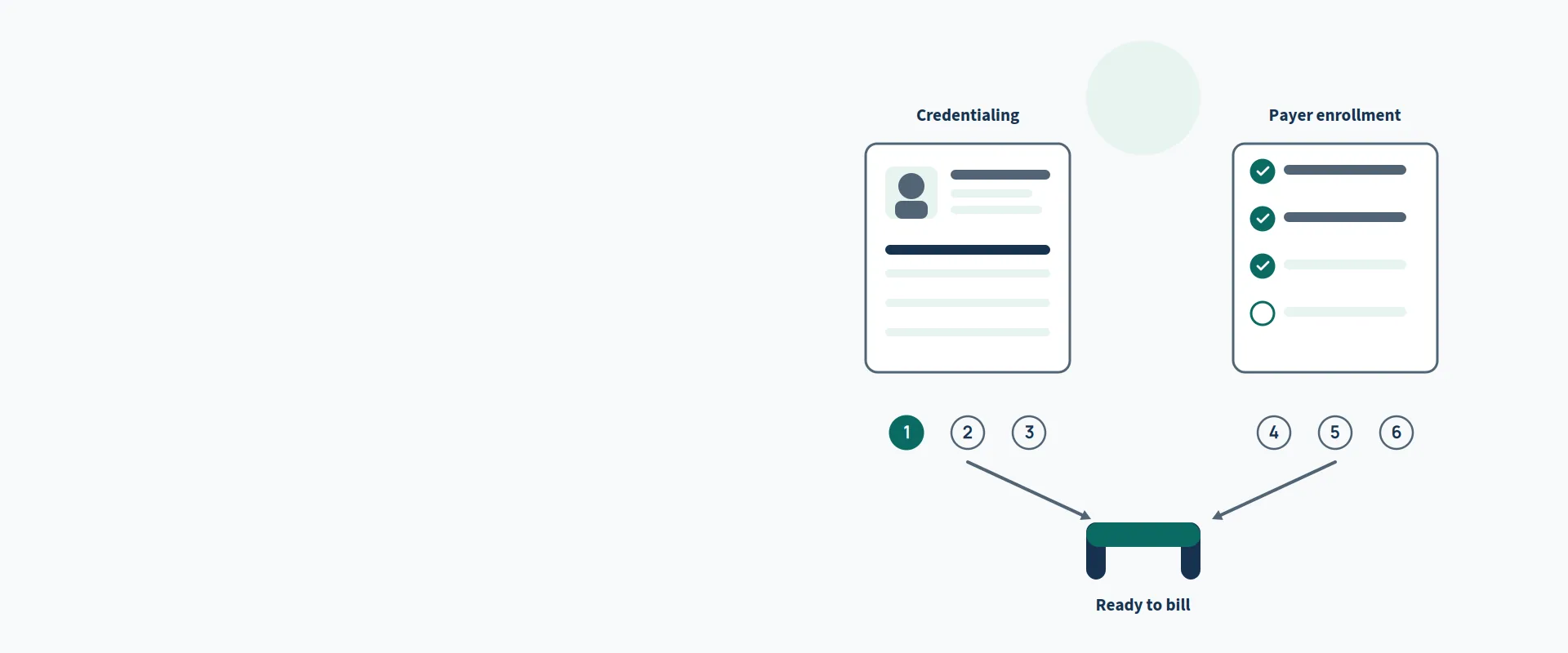
Credentialing and payer enrollment are two different jobs often sold as one. Medical Billing Services Group (MBSG) provides both as distinct workstreams: credentialing verifies a provider’s qualifications (education, training, licensure, board certification) so payers accept them into a network, while payer enrollment and contracting gets the provider enrolled and effective with each payer — application, approval, contract, and effective participation date. Confusing the two is how practices end up credentialed somewhere but unable to bill anywhere.
Direct answer: MBSG’s credentialing and payer enrollment service manages CAQH profiles, NPI records, Medicare enrollment, commercial payer applications and contracting, and revalidation cycles, with enrollment tracking and status reporting so you know where each provider stands with each payer. It suits new practices, newly hired providers, and groups adding payers or locations. Timelines vary by payer; status is reported, never assumed.
Get a Free Billing Audit — our limited-scope free assessment can reveal whether enrollment gaps are behind your unpaid claims. Or contact us to scope credentialing work.
Scope and suitable buyers
Credentialing verifies provider qualifications — education, residency and training, state licensure, board certification, work history, malpractice history — maintained in systems like CAQH ProView and the NPI registry. Payer enrollment is the separate process of applying to each payer (Medicare, Medicaid, each commercial plan), completing applications, signing participation agreements, and receiving an effective date from which claims will be paid. A provider can be fully credentialed yet have zero billable payers if enrollment was never completed; enrollment applications stall when credentialing data is incomplete. This service covers both workstreams and the tracking that keeps them synchronized.
Suitable buyers: new practices needing first-time enrollment across their payer mix; growing practices onboarding employed or contracted providers; practices adding locations, tax IDs, or service lines that trigger re-enrollment; groups that discovered — usually through denied claims — that a provider was never properly enrolled with an assumed payer. The service is administrative and procedural; it does not provide legal advice on participation terms, and contract language review remains your decision with counsel.
Workflow
Each provider-payer combination is tracked as its own enrollment case, from intake to effective date.
Inputs
We collect the provider’s credentialing packet: CV, education and training history, state licenses, DEA registration where applicable, board certifications, NPI, CAQH credentials and attestation status, malpractice coverage, and work history with explanations for gaps. For the practice: group NPI, tax ID, locations, and the target payer list in priority order. Data is handled under our standard HIPAA safeguards . Providers mid-enrollment with any payer are documented at their existing case status first — never duplicate-filed.
Quality checks
Applications are checked for completeness before submission — incomplete applications are the most common avoidable cause of enrollment delays, so every required attachment, signature, and attestation is verified against the payer’s published checklist. CAQH attestations and NPI data are kept current and consistent, because mismatches between CAQH, NPI, and the payer application routinely cause rejections. Medicare enrollment submissions follow CMS enrollment rules for the applicable provider type (note: Medicare rules do not automatically apply to Medicaid or commercial payers — each payer’s own requirements govern). Contract documents are checked to confirm the effective participation date before you bill that payer; billing before the effective date creates unbillable inventory.
Escalation and reporting
Each case carries a status: intake, submitted, pending payer review, additional information requested, approved, or effective. When a payer requests additional information, the response is prepared and tracked — stalled cases are escalated to you with the payer’s stated reason and available options, never left sitting silently. Revalidation and recredentialing cycles are calendared before they come due so participation never lapses unexpectedly. Regular status reporting shows every provider, every payer, the current stage, and effective dates achieved. Where delays are systemic, the report says so plainly with evidence rather than inventing a completion date.
Included and excluded work
Included: credentialing packet assembly and maintenance; CAQH profile setup, updates, and re-attestation; NPI record verification and updates; Medicare enrollment application preparation and submission; Medicaid and commercial payer enrollment applications; payer contracting support through effective participation date; revalidation and recredentialing calendar management; enrollment tracking with regular status reporting.
Excluded: legal review of payer contracts (refer to counsel); hospital or facility privileging (a separate institutional process); billing for services rendered before a payer’s effective date (we confirm the date; we cannot backdate it); active denial appeals on enrollment-related denials (handled by denial management, informed by our enrollment status reporting); eligibility verification and collections workflows (separate services in our services hub).
Onboarding and systems
Onboarding starts with a provider and payer inventory: who needs enrollment, with which payers, at which locations, by what target dates. Credentialing documents are collected through secure channels, and CAQH access is set up with the provider’s authorization — CAQH credentials always remain the provider’s. Existing in-flight enrollments are confirmed first to avoid duplicate filings. No system changes are required on your side; the service runs on payer portals, CAQH, NPPES, and our tracking records.
Pricing factors
Pricing reflects the number of providers, the number of payers per provider, and how many enrollments are first-time versus revalidation or recredentialing (revalidations are typically lighter than initial enrollments). Multi-state licensure and multiple locations add cases to track. Pricing model and minimums are quoted after the provider-payer inventory is confirmed. General engagement structure is on our medical billing pricing page.
Verified evidence
We report status, never assumption: submitted, pending, approved, or effective — each with the payer’s reference where available. Filings cite the applicable requirement: CMS Medicare enrollment rules for Medicare (noting where Medicaid and commercial payers differ), each commercial payer’s published enrollment checklist, and CAQH attestation requirements (sources noted with payer, program, and effective date; last reviewed 2026-10-07). We do not invent enrollment timelines — timelines vary by payer and application completeness, and any range discussed is framed as reported by the payer for that application, not as a promise. General educational information, not legal advice or a guarantee of reimbursement. Requirements vary by payer, plan, setting and date of service.
Get a Free Billing Audit to check whether enrollment gaps are costing you — or contact us to inventory your providers and payers.
FAQs
What is the difference between credentialing and payer enrollment?
Credentialing verifies the provider’s qualifications (education, licensure, board certification) through systems like CAQH. Payer enrollment is the separate process of applying to each payer, completing contracting, and receiving an effective participation date. You need both: credentialing without enrollment means you cannot bill that payer.
Do Medicare enrollment rules apply to Medicaid and commercial payers?
No. Medicare has its own CMS-administered enrollment rules; Medicaid programs and commercial payers each have their own applications, requirements, and timelines. Each filing is prepared to the specific payer’s published requirements.
What delays enrollment most often?
In general terms: incomplete applications (missing attachments, signatures, attestations), inconsistencies between CAQH, NPI, and the payer application, and payer-side processing backlogs. Our quality checks target the avoidable causes — completeness and consistency — before submission, and payer-side stalls are escalated to you with the documented reason.
How do we know the status of each enrollment?
Through regular status reporting listing every provider-payer combination, its current stage, and achieved effective dates. The report is the standing answer — you never have to ask where something stands.
Can you fix claims denied because a provider was not enrolled?
Enrollment work prevents future denials by completing enrollment properly. Claims already denied for enrollment reasons go through our denial management service, informed by the enrollment status we document. Services rendered before a payer’s effective date generally cannot be billed to that payer.
Who owns our CAQH credentials?
You do. We work within your CAQH profile with the provider’s authorization to keep attestations current; credentials are never transferred to us.
Get a Free Billing Audit — find out if enrollment gaps are behind your denials. To see how credentialing fits the full revenue cycle, visit our medical billing services hub or contact us.