
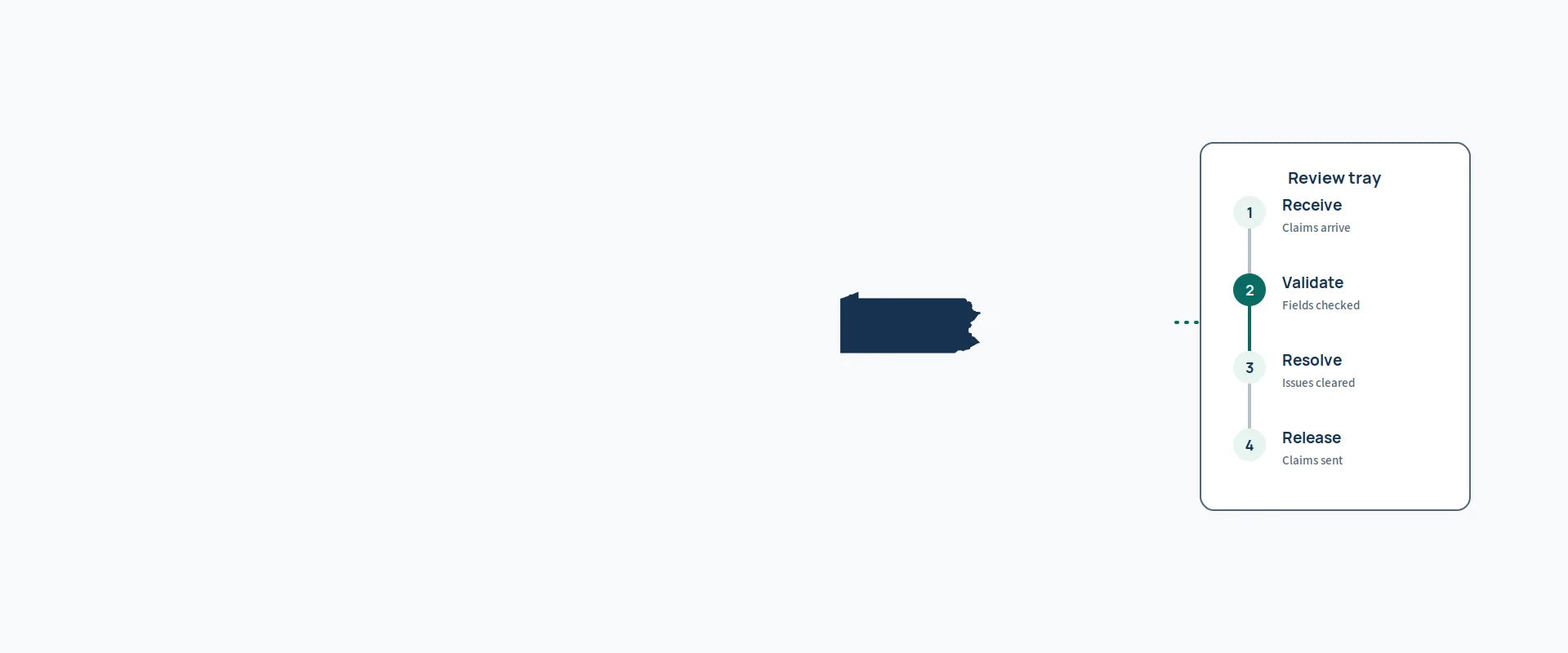
Pennsylvania runs its Medicaid billing through PROMISe, one of the more structured claims systems in the country — and one of the stricter on timing. Original claims get 180 days from the date of service, with a formal exception process for the ones that miss it. Knowing how that exception process works is the difference between recovering revenue and writing it off.
Medical Billing Services Group supports Pennsylvania practices remotely, with a US-based team working inside your existing systems. We serve practices in all 50 states from a single remote operation, and Pennsylvania accounts get PROMISe-specific workflows from day one.
PA Medical Assistance billing essentials
Pennsylvania’s Medicaid program is Medical Assistance (MA), administered by the Department of Human Services. Claims process through the PROMISe system. The rules that govern your revenue:
Original claims: 180 days. An original claim must be submitted within 180 days of the date of service. Adjustments and voids get 365 days. The 180-day clock is the operational deadline for every Pennsylvania practice.
The 180-day exception process. Claims that miss the window aren’t automatically dead — Pennsylvania offers a formal 180-day exception request for qualifying situations: eligibility was requested within 60 days of service, or a third-party payment was requested within 60 days of service. The request needs its own form, the claim, supporting documentation, and signature transmittal. Each exception needs a separate submission.
Resubmission discipline. PROMISe guidance is explicit: a claim not appearing within 45 days of submission should be resubmitted, and pended claims that don’t resolve within another 45 days should be resubmitted immediately. Passive waiting is how Pennsylvania claims age out.
Managed care layering. Pennsylvania delivers much of its Medicaid through HealthChoices managed care plans, each with its own filing rules (commonly 180 days) layered over the state framework. FFS knowledge and plan knowledge are separate disciplines.
Where Pennsylvania practices lose revenue
Missing the exception window. The 180-day exception process exists, but it has its own paperwork and its own clock. Practices that discover aged claims at month eight often can’t assemble the documentation in time. Exception-eligible claims need to be identified early, not during year-end cleanup.
Passive claim monitoring. PROMISe’s 45-day resubmission guidance exists because claims genuinely disappear. Practices without active claim-status monitoring lose claims to the void — never denied, never paid, just gone past the deadline.
Managed care authorization denials. HealthChoices plans layer prior authorization requirements onto state coverage rules. “No authorization on file” denials are preventable only with front-end verification — our eligibility verification and prior authorization service.
Adjustment errors. Adjustments and voids have a 365-day window, but they require the original claim’s ICN in the right field. Mis-keyed adjustments deny for timely filing even when the underlying claim was on time.
How MBSG supports Pennsylvania practices
We provide full medical billing services and revenue cycle management for Pennsylvania practices, including:
- PROMISe and HealthChoices claims submission — clean claims with active 45-day status monitoring, so nothing disappears quietly.
- Denial management — root-cause analysis, 180-day exception request preparation where qualifying circumstances exist, and corrected-claim workflows inside the 365-day adjustment window.
- Eligibility verification and prior authorization — front-end checks that prevent authorization and eligibility denials.
- Credentialing and payer enrollment — PA Medical Assistance enrollment, PROMISe provider ID management, and plan contracting.
- Medical billing audits — coding reviews targeting Pennsylvania’s most frequent denial reasons.
- Clearinghouse connectivity — electronic submission with acceptance reports as proof of timely filing.
Smaller Pennsylvania practices can use our small-practice billing support. Evaluating a change? See outsourced medical billing.
Specialties we serve in Pennsylvania
Billing adapts to specialty coding rules — including behavioral health, cardiology, gastroenterology, oncology, pediatrics, internal medicine, OB-GYN, orthopedic, and urology. Browse all specialties and our services.
Get a Free Billing Audit.
If 180-day misses, vanishing PROMISe claims, or HealthChoices denials are costing your Pennsylvania practice, start with a Free Billing Audit. We review recent claims and show you exactly where revenue is leaking.
Call +1 (307) 396-4107 or email contact@medicalbillingservicesgroup.com. Pricing is quoted in your written proposal after we review your volume and payer mix — see medical billing pricing. Data is handled under our HIPAA safeguards and business associate agreement (HIPAA & security).
Frequently asked questions
What is the Pennsylvania Medicaid timely filing limit?
180 days from the date of service for original claims; 365 days for adjustments and voids. A formal 180-day exception process exists for qualifying circumstances. (Confirm against current DHS/PROMISe guidance; rules change.)
Does MBSG have a Pennsylvania office?
No. We are a remote company serving all 50 states, working inside your existing EHR and practice management system.
What is the 180-day exception process?
A formal request path for claims that missed the window due to qualifying circumstances (timely eligibility or third-party requests). It requires its own form, documentation, and signature — we prepare these where your claims qualify.
How do you prevent claims from disappearing in PROMISe?
Active status monitoring: claims not appearing within 45 days are resubmitted, and pended claims get followed up before the next 45-day mark.
Do you bill HealthChoices managed care plans?
Yes — each plan gets its own filing calendar and denial workflow, separate from fee-for-service.
How do we start?
Get a Free Billing Audit. We analyze your recent claims and denial patterns before you commit to anything.
General educational information, not legal advice or a guarantee of reimbursement. Requirements vary by payer, plan, setting and date of service. Coding references last reviewed 2026-10-08.