
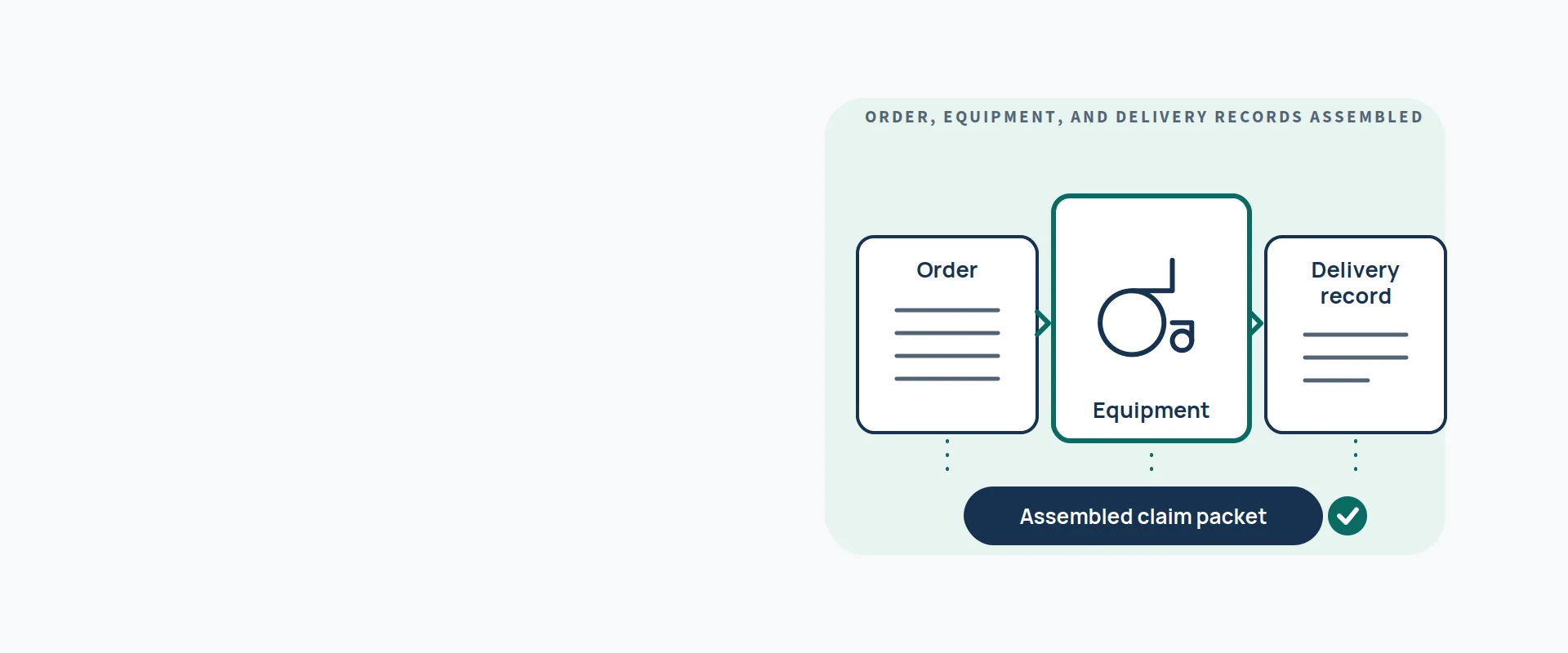
DME billing services from Medical Billing Services Group (MBSG) keep durable medical equipment claims clean — from power mobility and orthoses to support surfaces, compression devices, and prosthetics. We handle prior authorizations, written-order and face-to-face documentation review, and denials, so your supply operation captures the full value of every item delivered.
DME denials eating your margins? Get a Free Billing Audit — we will review your DMEPOS claims and pinpoint exactly where revenue is leaking.
Practice/setting fit
Our DME billing services fit DMEPOS suppliers, orthotic and prosthetic practices, home medical equipment companies, and specialty clinics that furnish equipment incident to care. What makes DME billing hard is that the documentation burden sits upstream of the claim: Medicare requires specific orders, face-to-face encounters, and medical-necessity records completed before delivery — and a claim for a perfectly appropriate item denies when any upstream element is missing or misdated.
We manage the full revenue cycle for these settings: prior authorization for covered HCPCS categories, order and encounter documentation review before delivery, coding with the correct HCPCS and modifiers (including rental modifiers), daily claim submission to the DME MACs, payment posting, and denial follow-up that goes back to the order file. We work inside your existing systems — compatibility is confirmed during onboarding — and our broader specialty billing programs cover your other service lines.
Documentation and coding risks
DME’s biggest billing risk is timing: the order, the encounter, and the delivery must happen in the right sequence with the right dates. These are the rules we apply most often, each verified against a published CMS source.
More DMEPOS categories require prior authorization every year
Fee-for-service Medicare requires prior authorization — reviewed by the DME MACs before delivery — for lower limb prostheses, certain orthoses, pneumatic compression devices, power mobility devices, and pressure-reducing support surfaces. Decisions come within 5 business days, and the list keeps growing: a July 2026 Federal Register notice (CMS-6109-N) added eight more HCPCS codes to the Required Prior Authorization List effective October 28, 2026, including an air-fluidized bed, an ultralightweight wheelchair, and six orthoses. Delivering first and authorizing later is not an option — the affirmation must precede the claim. We track which of your items sit on the current list, submit requests with the medical documentation the DME MAC expects, and hold delivery workflows until the decision is in hand.
Payer/program: Medicare (CMS via DME MACs) · Jurisdiction: United States (federal) · Source: “CGS Medicare — Prior Authorization for DMEPOS (program table: LLP, Orthoses, PCD, PMD, PRSS; 5-business-day decisions); Federal Register CMS-6109-N (91 FR 47972), July 30, 2026 — 8 codes added effective October 28, 2026” · Publication date: July 30, 2026 (FR notice) · Effective date: October 28, 2026 (new codes) · Last reviewed: 2026-10-08
The written order and face-to-face rules deny more claims than coding does
For covered DMEPOS items, Medicare requires a detailed written order and, for specified items, a face-to-face encounter with the treating practitioner before delivery — documented in the medical record with the clinical findings that support medical necessity. The order must contain the beneficiary’s name, the item ordered, the practitioner’s signature and date, and it must predate the claim. Backdated or incomplete orders are among the most common reasons DME claims fail medical review. Our pre-delivery checklist verifies the order elements, the encounter date, and the supporting notes before the item ships, because after delivery the documentation cannot be recreated.
Payer/program: Medicare (CMS) · Jurisdiction: United States (federal) · Source: “CMS DMEPOS documentation requirements — detailed written order and Face-to-Face and Written Order Prior to Delivery list (see the current Federal Register Master List notice for your items)” · Publication date: ongoing CMS guidance · Effective date: ongoing · Last reviewed: 2026-10-08
Rental versus purchase and ongoing medical necessity
Many DME items are paid on a rental basis first, with purchase only after rental payments reach the purchase price — and continued rental months require ongoing medical necessity in the record. Modifier discipline matters here: the wrong rental modifier or a missing one changes what the MAC pays. For items like power mobility devices, the medical-necessity documentation must support not just the base item but the specific accessories billed with it. We manage the rental-month calendar, verify that continued-need documentation is in the file before each rental claim, and code accessories only where the record supports them.
Payer/program: Medicare (CMS via DME MACs) · Jurisdiction: United States (federal) · Source: “DME MAC Supplier Manuals — rental/payment rules and accessory coverage criteria (check your DME MAC’s current manual)” · Publication date: ongoing · Effective date: ongoing · Last reviewed: 2026-10-08
Not sure your DME documentation would survive an audit? Get a Free Billing Audit — we will test a sample of claims against the rules above and show you the gaps.
Payer and authorization checks
Medicare’s DMEPOS rules above apply to fee-for-service claims billed to the DME MACs. Medicare Advantage plans, Medicaid programs, and commercial payers each run their own DME authorization and documentation requirements — many mirror Medicare’s, but the forms, portals, and timelines differ. We verify the payer’s requirement for each item before delivery, submit what the payer asks for, and track every request to a written determination.
Workflow and reporting
DME revenue lives in the order file, so our workflow starts before delivery. We verify benefits and prior authorization status, check the written order and face-to-face documentation against a pre-delivery checklist, code with correct HCPCS and rental modifiers, submit daily to the DME MACs, post payments, manage rental-month calendars, and work denials through our structured denial management process.
Reporting makes the pattern visible. Illustrative examples of what our reports show: a weekly denial snapshot grouped by root cause (prior authorization, order documentation, medical necessity, coding), days in AR by payer, and a clean-claim rate trend for your equipment lines. These are illustrative examples, not guarantees — results depend on payer mix, documentation quality, and product mix. But you will always see where revenue stands and what we are doing about it.
Onboarding and pricing factors
Onboarding starts with the free billing audit — a real review of recent claims, not a sales call. Implementation then covers supplier enrollment verification (including Medicare supplier number standing), DME MAC and clearinghouse connections, order-workflow mapping, and a documentation review of your highest-volume HCPCS categories. Factors that shape a quote: monthly claim and delivery volume, product mix (power mobility, orthoses, support surfaces, prosthetics), number of locations, payer mix, and whether you need full revenue cycle or billing only.
We do not publish one-size-fits-all rates because they would be meaningless at this complexity. Your proposal will specify the pricing model, minimum fees, and turnaround for implementation, along with the credentials of the team assigned to your account. Data is handled under our HIPAA safeguards and business associate agreement. We serve suppliers in all 50 states — call +1 (307) 396-4107 or email contact@medicalbillingservicesgroup.com, or review transparent pricing details.
FAQs and dated sources
Do you handle DMEPOS prior authorizations?
Yes. We track which of your HCPCS codes sit on Medicare’s Required Prior Authorization List, prepare the request with medical documentation, submit to the DME MAC before delivery, and hold the delivery workflow until the decision arrives — since affirmation must precede the claim.
What is the most common reason DME claims deny?
Documentation timing and completeness: missing or backdated detailed written orders, missing face-to-face encounters, and medical-necessity notes that do not support the item delivered. Coding errors are a distant second.
Do you bill rental months and accessories?
Yes. We manage rental-month calendars with continued-need documentation checks, apply the correct rental modifiers, and code accessories only where the record supports the base item and the add-on.
Do Medicare DME rules apply to our Medicare Advantage contracts?
Not automatically. Medicare Advantage plans have their own authorization processes and documentation requirements. We check each plan’s rules rather than assuming fee-for-service policies govern.
How do we start working with MBSG?
Start with a free billing audit — we review recent claims across your equipment lines. Or contact our team directly to talk through your volume and product mix.
Medical Billing Services Group — Medical Billing & Revenue Cycle Management. If DME documentation complexity is costing you deliveries’ worth of revenue, start with a Free Billing Audit and see exactly where your claims stand.
General educational information, not legal advice or a guarantee of reimbursement. Requirements vary by payer, plan, setting and date of service.
CPT is a registered trademark of the American Medical Association. HCPCS is maintained by the Centers for Medicare & Medicaid Services.