
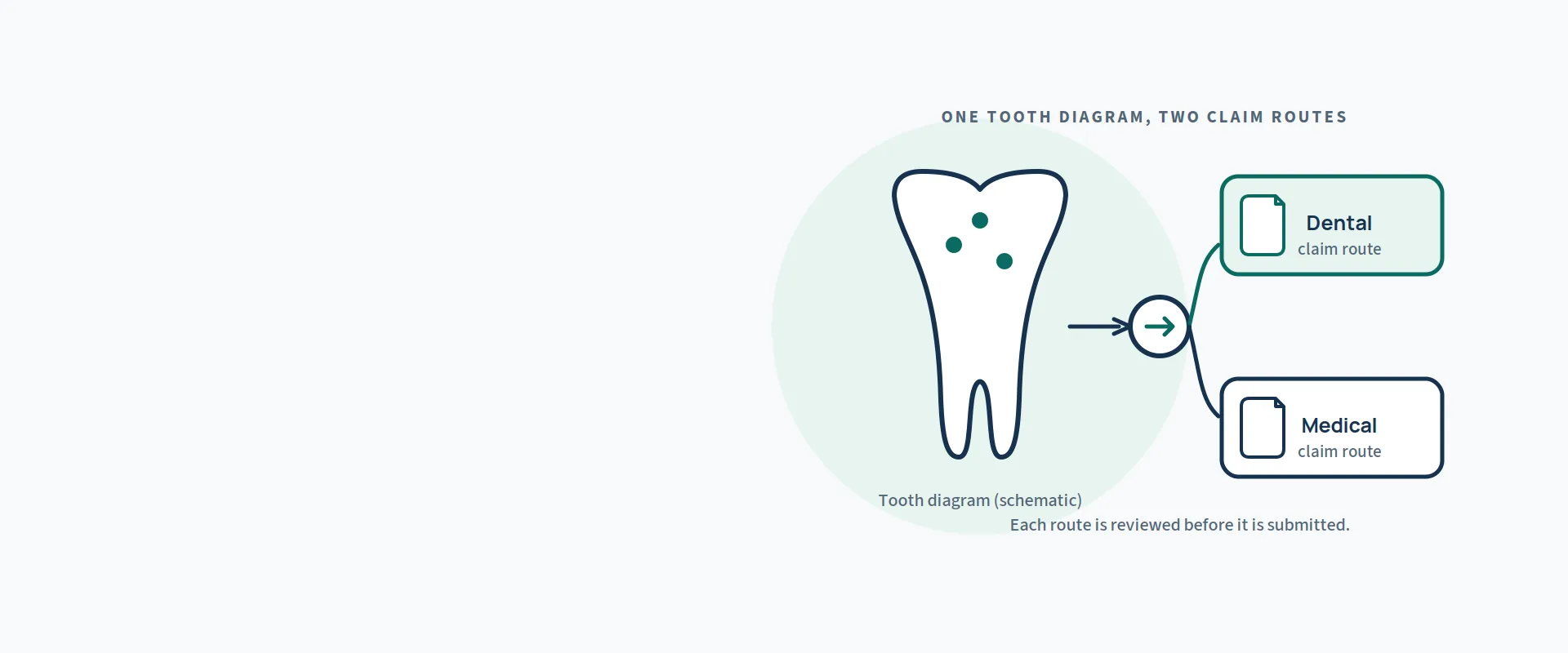
Medical billing for dental practices from Medical Billing Services Group (MBSG) handles the cases where dentistry meets medicine — trauma, TMJ disorders, sleep apnea, oral and maxillofacial surgery, and dental services tied to covered medical treatment. We coordinate dental and medical billing so the right claim goes to the right payer on the right form. This page is not about routine dental claims; it is about getting paid when dental care is medically necessary.
Dental-medical crossover claims getting denied? Get a Free Billing Audit — we will review your trauma, TMJ, and oral surgery claims and pinpoint exactly where revenue is leaking.
Practice/setting fit
Our dental billing services fit oral and maxillofacial surgery practices, TMJ and orofacial pain clinics, dental sleep medicine practices, and general or specialty dental practices that treat trauma or medically complex patients. What makes this billing hard is the two-payer problem: the same clinical event can generate a dental claim (837D) and a medical claim (CMS-1500/837P), each with its own coding system, medical-necessity rules, and timely-filing limits — and sending the claim to the wrong payer is an automatic denial.
We manage the full revenue cycle for these settings: verifying both dental and medical benefits, determining which payer is primary for the diagnosis at hand, coding across CDT and CPT/ICD-10-CM where the case supports it, submitting on the correct claim form, posting payments, and working denials through our structured denial management process. Our coding team handles the dental-medical crossover, and our broader specialty billing programs cover the rest of your service lines.
Documentation and coding risks
Dental-medical billing fails most often on payer selection and form selection — not on the dentistry. These are the rules we apply most often, each verified against a published source.
Medicare now pays for dental services tied to covered medical care
Since January 1, 2023, Medicare Parts A and B may pay for dental services that are “inextricably linked to, and substantially related and integral to the clinical success of” certain covered medical services. The covered scenarios started with dental exams and treatment to eliminate oral infection before or alongside organ transplants (organ, stem-cell, bone marrow), cardiac valve replacements, and valvuloplasty procedures. This was a genuine policy change — before it, Medicare’s dental exclusion was nearly absolute. For dental practices treating medically complex patients, it opened a billing path that did not exist before, but only when the linkage to the covered service is documented.
Payer/program: Medicare (CMS) · Jurisdiction: United States (federal) · Source: “CY 2023 Physician Fee Schedule Final Rule (CMS-1770-F), clarifying Medicare payment for dental services inextricably linked to covered medical services” · Publication date: November 1, 2022 · Effective date: January 1, 2023 · Last reviewed: 2026-10-08
The 2024 and 2025 expansions changed what dental practices can bill
CMS has widened the covered scenarios every year since. The CY 2024 Physician Fee Schedule final rule added dental services tied to head and neck cancer treatment, chemotherapy, CAR-T cell therapy, and high-dose antiresorptive (bone-modifying) therapy, effective January 1, 2024. The CY 2025 final rule added dental examinations and infection-elimination services tied to Medicare-covered dialysis for end-stage renal disease. And effective July 1, 2025, CMS requires the KX modifier on claims for dental services the clinician believes are inextricably linked to covered medical services, plus a diagnosis code on 837D dental claim submissions. Miss the modifier or the diagnosis code and the claim fails on a technicality — even when the service was covered.
Payer/program: Medicare (CMS) · Jurisdiction: United States (federal) · Source: “CY 2024 and CY 2025 Physician Fee Schedule Final Rules — expanded clinical scenarios; KX modifier and 837D diagnosis-code requirements effective July 1, 2025” · Publication date: November 2023 (2024 rule); November 1, 2024 (2025 rule) · Effective date: January 1, 2024; July 1, 2025 (KX/diagnosis-code requirements) · Last reviewed: 2026-10-08
Medical versus dental claim forms: the right claim to the right payer
Trauma, TMJ disorders, obstructive sleep apnea appliances, and oral surgery are routinely billed to medical insurance — on the CMS-1500/837P with CPT and ICD-10-CM — while routine dental work goes on the 837D with CDT codes. The documentation must support the medical diagnosis: a sleep apnea appliance needs the sleep study and diagnosis in the record, and trauma cases need the injury documented as the medical reason for treatment. Both the dental and medical providers must be enrolled in Medicare where Medicare billing applies. We determine payer primacy from the diagnosis before the claim is built, submit on the correct form with the correct code set, and track both claim streams so nothing falls between the two payers.
Payer/program: varies by payer · Jurisdiction: United States · Source: “CMS guidance on dental-medical billing coordination — both practitioners must be enrolled in Medicare and meet all billing requirements where Medicare payment applies” · Publication date: ongoing CMS guidance · Effective date: ongoing · Last reviewed: 2026-10-08
Not sure your crossover claims would survive an audit? Get a Free Billing Audit — we will test a sample of claims against the rules above and show you the gaps.
Payer and authorization checks
Medicare’s dental-coverage rules above apply only to the scenarios CMS has finalized — routine dental care remains excluded, and commercial and Medicaid dental benefits vary widely by plan and state. Medical payers that cover TMJ, trauma, and sleep apnea each have their own medical-necessity criteria and prior authorization requirements. We verify both dental and medical benefits before treatment, confirm which payer is primary for the diagnosis, obtain prior authorization where the medical payer requires it, and track authorizations to written determinations.
Workflow and reporting
Dental-medical revenue lives in the diagnosis and the claim form, so our workflow starts with both. We verify dual benefits, determine payer primacy, code across CDT and CPT/ICD-10-CM as the case supports, submit on the correct form (837D for dental, 837P/CMS-1500 for medical), post payments from both streams, and reconcile them so crossover cases are fully accounted for.
Reporting makes the pattern visible. Illustrative examples of what our reports show: a weekly denial snapshot grouped by root cause (wrong payer, wrong form, missing KX modifier, medical necessity, coding), days in AR by payer, and a clean-claim rate trend for your crossover and routine lines. These are illustrative examples, not guarantees — results depend on payer mix, documentation quality, and case mix. But you will always see where revenue stands and what we are doing about it.
Onboarding and pricing factors
Onboarding starts with the free billing audit — a real review of recent claims, not a sales call. Implementation then covers payer enrollment verification (dental and medical), clearinghouse and practice-management connections, crossover charge-capture mapping, and a coding review of your highest-volume crossover procedures. Factors that shape a quote: monthly claim volume across both streams, the share of trauma/TMJ/sleep/surgical cases, number of providers and locations, payer mix, and whether you need full revenue cycle or billing only.
We do not publish one-size-fits-all rates because they would be meaningless at this complexity. Your proposal will specify the pricing model, minimum fees, and turnaround for implementation, along with the credentials of the team assigned to your account. We serve practices in all 50 states — call +1 (307) 396-4107 or email contact@medicalbillingservicesgroup.com, or review transparent pricing details.
FAQs and dated sources
Do you handle routine dental insurance claims?
That is not this service’s focus. This page covers medical billing for dental practices — trauma, TMJ, sleep apnea, oral surgery, and Medicare-linked dental cases where dental and medical billing must be coordinated. If your need is routine 837D dental claims only, tell us and we will say plainly whether we are the right fit.
Can Medicare really pay for dental services?
In the specific scenarios CMS has finalized — dental care inextricably linked to organ transplants, cardiac valve procedures, head and neck cancer treatment, chemotherapy, CAR-T therapy, antiresorptive therapy, and ESRD dialysis — yes, since 2023, with expansions in 2024 and 2025. Routine dental care remains excluded.
What is the KX modifier requirement?
Since July 1, 2025, CMS requires the KX modifier on claims for dental services the clinician believes are inextricably linked to covered medical services, plus a diagnosis code on 837D submissions. We apply both as a matter of routine.
How do you decide whether a case goes to dental or medical insurance?
From the diagnosis. Trauma, TMJ disorders, and sleep apnea with a documented medical diagnosis go to the medical payer on the CMS-1500/837P; routine dental work goes on the 837D. We verify both benefits before treatment so the claim is built for the right payer the first time.
How do we start working with MBSG?
Start with a free billing audit — we review recent claims across your dental and medical streams. Or contact our team directly to talk through your case mix and payer panel.
Medical Billing Services Group — Medical Billing & Revenue Cycle Management. If dental-medical crossover complexity is costing you cases’ worth of revenue, start with a Free Billing Audit and see exactly where your claims stand.
General educational information, not legal advice or a guarantee of reimbursement. Requirements vary by payer, plan, setting and date of service.
CPT is a registered trademark of the American Medical Association. CDT is a registered trademark of the American Dental Association.