
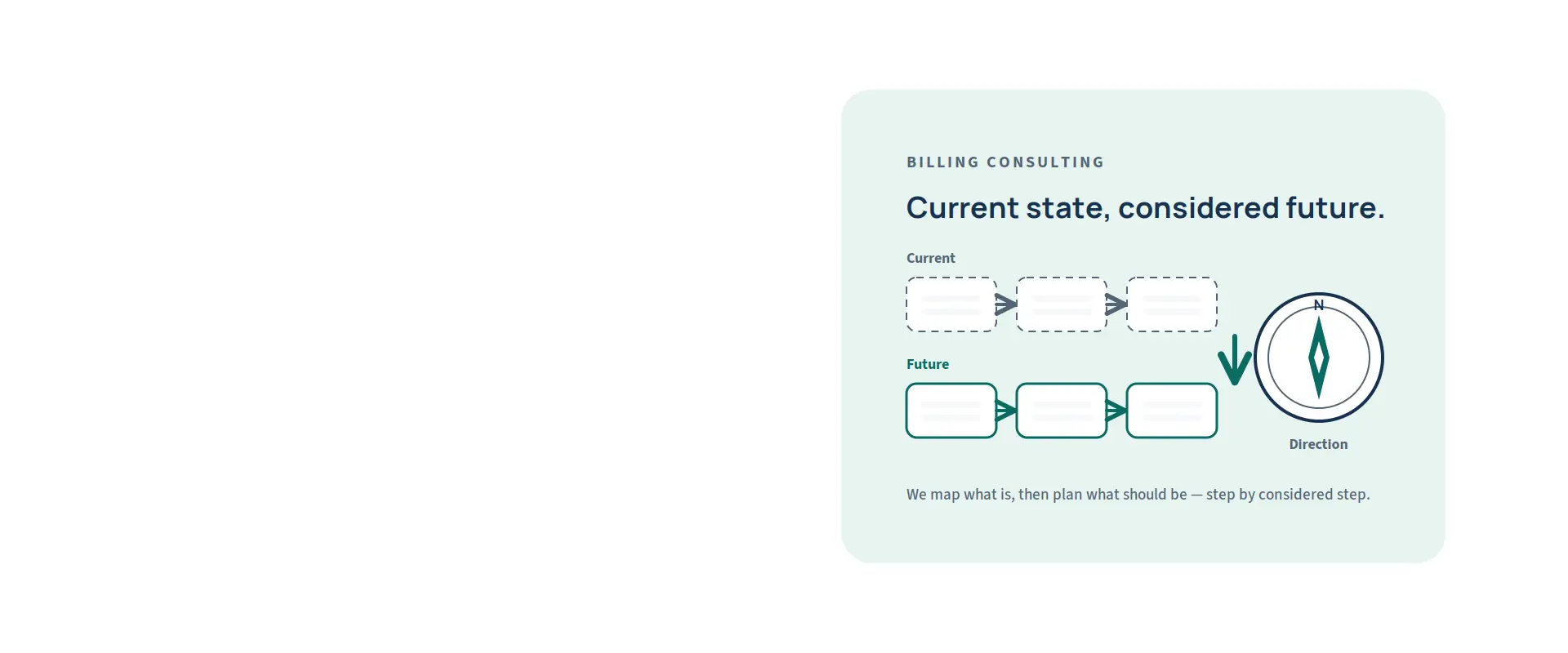
Some practices don’t need someone to run their billing — they need an experienced outside view of why it isn’t working. Medical Billing Services Group (MBSG) offers medical billing consulting as a distinct advisory service: structured assessments, workflow redesign, and practical recommendations your own team can execute, separate from the day-to-day work of outsourced billing operations.
A direct answer: Medical billing consulting is advisory work — assessing your revenue cycle, diagnosing the causes of denials, slow payments, or rising costs, and delivering prioritized recommendations your staff implements. MBSG’s consulting engagements produce findings and action plans, not ongoing claim processing; practices that want the work done for them instead should look at our outsourced medical billing services.
If you suspect revenue is leaking but can’t see where, Get a Free Billing Audit — it often surfaces the same issues a consulting assessment would. Or contact us to scope an engagement.
What Consulting Covers — and Who It’s For
Consulting engagements focus on diagnosis and design: examining how claims, denials, payments, and patient balances move through your organization, finding where the process breaks down, and recommending specific changes — sequenced by impact and effort — your team can carry out.
Common consulting engagements include:
- Revenue cycle assessments. A structured review of the full cycle — registration through patient collections — benchmarked against your own historical performance to find the largest gaps first.
- Billing workflow redesign. Rebuilding broken handoffs between the front desk, clinical staff, coders, and billers: who owns each step, what “done” looks like, and where work currently stalls or gets duplicated.
- Staff training support. Targeted training for in-house billing staff on denial prevention, clean-claim practices, payer-specific rules, and follow-up discipline — built around your actual denial data, not generic coursework.
- Payer contract review support. Helping practices read what their payer agreements actually require and pay: fee schedule analysis, prompt-payment terms, and identification of contract terms that may be costing revenue. This is operational analysis, not legal advice.
- Interim billing leadership support. Short-term guidance for practices between billing managers — stabilizing cash flow, setting priorities for the team, and documenting processes so the next hire inherits a working operation instead of a backlog.
- Technology selection guidance. Independent input on practice management, EHR, clearinghouse, and denial-management tooling decisions: what to require in a vendor evaluation, how to compare proposals, and which implementation pitfalls to avoid.
Consulting suits practices with an underperforming in-house billing team and a leader who wants to know why; groups preparing to bring billing back in-house or change vendors; organizations adding locations or specialties where the current process won’t scale; and leadership teams wanting an objective second opinion before a larger operational change.
How a Consulting Engagement Works
Inputs
We start with access and data, not opinions: recent claim and remittance data, denial and adjustment reports, aging reports, payer mix, staffing structure, and the systems currently in use. We also interview the people who do the work — billers, front-desk staff, and practice leadership — because the reports show what happened and the staff know why. A business associate agreement is signed before any data exchange; protected health information is handled per our privacy policy and HIPAA security overview.
Quality Checks
Findings are validated before they become recommendations. We triangulate — a denial trend in the reports is checked against actual remittance records and payer policy sources, and a workflow complaint from one interview is checked against what others describe and what the data shows. We do not present industry benchmarks we cannot source, and we distinguish clearly between what your data proves, what it suggests, and what remains unknown. Recommendations cite the evidence behind them so your leadership can defend the decisions.
Escalation
Some findings can’t wait for the final report. When an assessment surfaces an urgent risk — a compliance exposure in billing practices, a cash-flow threat from a stalled payer enrollment, or a process failure actively losing revenue — we flag it to practice leadership immediately, with the evidence and the recommended immediate action. Routine findings wait for the report; urgent ones don’t.
Reporting
Engagements close with a written findings report and a prioritized action plan: what to fix, in what order, with estimated effort and expected effect for each item. Deliverables here are illustrative — exact contents are defined per engagement — but a typical package includes assessment findings, redesigned workflow documentation, training materials where applicable, and a follow-up implementation review. Reports are written for decision-makers, not billing technicians.
Need advice rather than a vendor? Get a Free Billing Audit for a first look — or contact us to discuss an engagement.
Included and Excluded Work
Included: revenue cycle assessments; workflow analysis and redesign documentation; staff training support built around your data; payer contract review support (operational analysis); interim billing leadership guidance; technology selection guidance; written findings and prioritized action plans.
Excluded: ongoing claim processing, denial follow-up, and payment posting — that is managed operations, covered by our outsourced medical billing and revenue cycle management services. Also excluded: legal advice, coding of individual encounters as a production service (see medical coding services), and credentialing execution (see credentialing and payer enrollment). Consulting recommendations are advisory; implementation remains your decision and responsibility. General educational information, not legal advice or a guarantee of reimbursement. Requirements vary by payer, plan, setting, and date of service.
Onboarding and Systems
Consulting engagements begin with a scoping conversation: the problem as you see it, the data available, the timeline, and who needs to be involved. We then define the engagement scope in writing — objectives, data requirements, deliverables, and schedule — before any assessment work starts. Engagements are typically fixed-scope and time-boxed, sized to the practice’s complexity. We work with the systems and reports you already have; no software change is required to benefit from an assessment.
Pricing Factors
Consulting is scoped and priced per engagement, not as a percentage of collections. The main cost drivers are the breadth of the assessment (a single workflow versus the full revenue cycle), the number of locations and specialties, the volume and condition of the data to be analyzed, and whether deliverables include training delivery or interim leadership time. Exact fees are quoted after the scoping conversation — see medical billing pricing for how our other services are priced.
Verified Evidence
We publish only verified results on this page. As of the last review, no consulting case studies have been cleared for publication, and we do not invent client outcomes, credentials, or statistics. What an assessment reliably delivers does not require a case study to state: a clear, evidence-backed picture of where your revenue cycle is actually losing money, and a sequenced plan to fix it.
Frequently Asked Questions
How is consulting different from outsourced medical billing?
Consulting produces advice — assessments, findings, redesigned workflows, and recommendations your team implements. Outsourced medical billing is operational — we do the billing work itself: claim submission, denial follow-up, payment posting, and patient billing. Some clients start with consulting to diagnose the problem, then choose outsourcing to fix it; others use consulting to improve the team they already have.
Do you implement the recommendations yourselves?
Implementation support can be included in the engagement scope — for example, delivering staff training or guiding a workflow rollout — but the engagement remains advisory. If you want MBSG to take over ongoing billing operations, that is a separate managed service with its own agreement.
What data will you need from us?
Typically: recent claim and remittance data, denial and adjustment reports, A/R aging reports, payer mix, and your current staffing structure — plus interviews with the staff who do the work. The exact list is defined during scoping. A business associate agreement is signed before any data is exchanged.
Is payer contract review legal advice?
No. Our payer contract review support is operational analysis — what the contract pays, what it requires operationally, and where terms may be costing you revenue. It is not legal advice, and we recommend having your attorney review any contract before you sign or renegotiate.
How long does an engagement take?
It depends on scope: a focused workflow review can take a few weeks, while a full multi-location revenue cycle assessment takes longer. Timelines are set in the written engagement scope before work begins.