
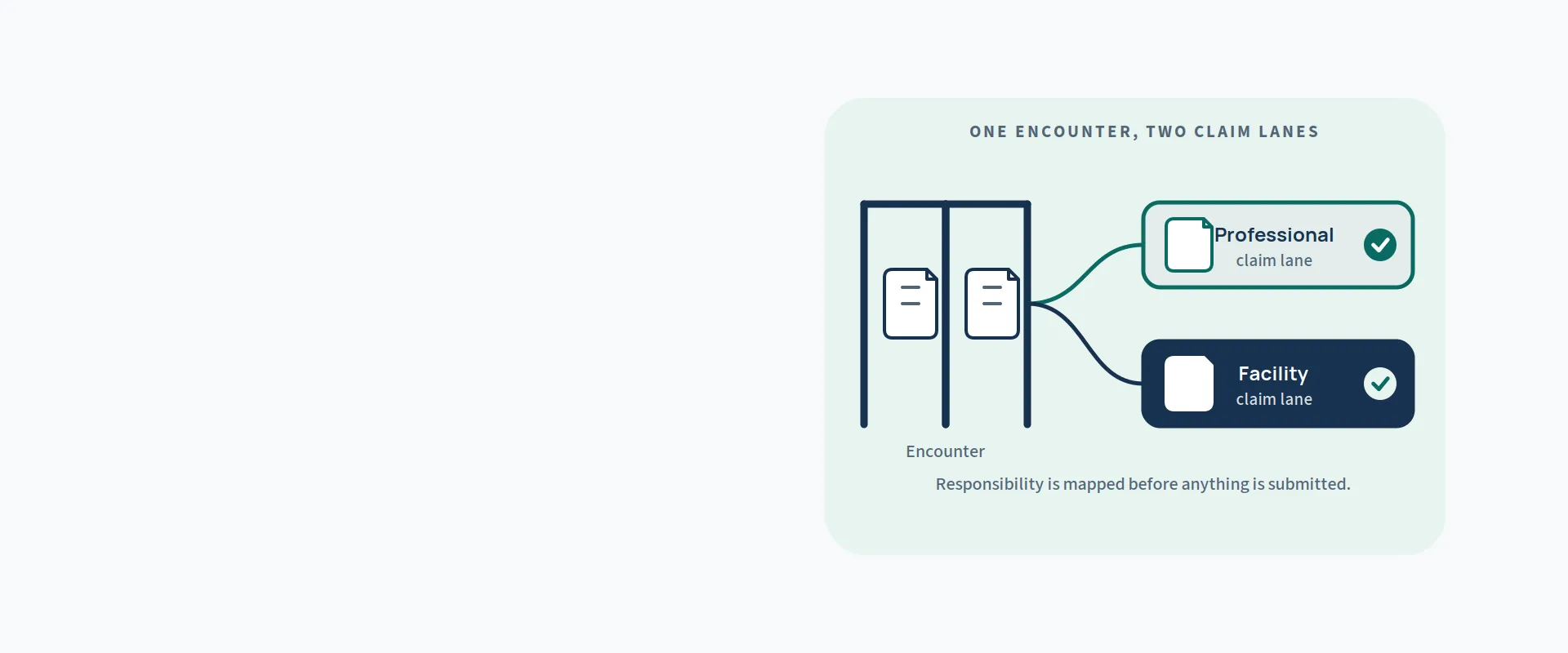
Emergency department billing services from Medical Billing Services Group (MBSG) cover both sides of the ED claim — professional services for the emergency physicians and advanced practice clinicians, and facility services for the hospital or freestanding ED. We handle ED E/M leveling, critical care time, OPPS packaging rules, and EMTALA-safe workflows, so your department captures legitimate revenue without compliance risk. This page covers facility and hospital ED coding — not ambulance or EMS transport billing, which is a separate discipline.
ED denials and compliance exposure keeping you up at night? Get a Free Billing Audit — we will review your professional and facility ED claims and pinpoint exactly where revenue is leaking.
Practice/setting fit
Our emergency department billing services fit hospital emergency departments, freestanding emergency departments, and emergency medicine physician groups — including groups staffing multiple EDs. ED billing is two revenue cycles running in parallel on the same patient encounter. The professional claim (CMS-1500) carries the physician’s E/M or critical care codes; the facility claim (UB-04) carries the hospital’s resources under the Outpatient Prospective Payment System (OPPS), packaged into Ambulatory Payment Classifications (APCs).
What makes ED billing hard is that clinical urgency and billing precision have to coexist. The chart is written for resuscitation, not for coders. Critical care time must be documented in minutes. Trauma activations have their own reporting rules. Observation stays blur into inpatient admissions. And overlaying everything is EMTALA — the federal requirement that every patient gets a medical screening examination regardless of ability to pay, before any discussion of insurance or payment. Billing workflows must never create even the appearance of delaying or discouraging the screening exam.
We manage both sides of the ED revenue cycle: professional coding from the ED provider note, facility coding under OPPS rules, daily claim submission on both claim forms, payment posting with contractual adjustments, and denial follow-up that distinguishes professional-side from facility-side root causes. Our coding team codes ED encounters against published edit rules before claims go out, and our broader specialty billing programs cover your other service lines.
Documentation and coding risks
ED documentation fails in predictable places, and each one maps to a denial category:
ED E/M leveling. Professional ED visits are reported with 99281–99285, leveled on medical decision making. Under-documented MDM is the classic ED downcode trigger — the note says “chest pain, EKG, labs, discharged” without the clinical reasoning that supports the level. We level from the note as written and flag encounters where documentation doesn’t support the billed level.
Critical care time. Critical care (99291/99292) is time-based: the first 30–74 minutes support 99291, with each additional 30-minute block supporting 99292. Time must be explicitly documented, and only time the physician spends on the critically ill patient counts. Vague “critical care provided” notes without minutes don’t survive review. We reconcile billed critical care against documented time.
Facility APC assignment. Under OPPS, the facility claim’s payment is driven by APC assignment, which depends on coded procedures, visit levels, and — for trauma — activation criteria. CMS distinguishes Type A dedicated emergency departments (open 24/7 with EMTALA obligations) from Type B departments for visit-level reporting. Miscoded visit levels or missed trauma activation reporting shift the APC and the payment. (Coding references last reviewed 2026-10-08; OPPS rules update annually — verify against the current final rule.)
Observation versus inpatient. The decision to observe, admit, or discharge drives both the claim type and medical-necessity review. Observation billed without the required documentation, or short inpatient stays without admission justification, draw payer scrutiny. We code the status the documentation supports and flag encounters where the status and the note disagree.
NCCI edits across the encounter. Procedure-to-procedure edits apply to ED professional claims — laceration repair with debridement, E/M with procedures, imaging with interpretation — and each combination has bundling rules with specific exceptions. We check edits across the full encounter.
Payer and authorization checks
The emergency setting changes the authorization picture fundamentally. Under EMTALA, the medical screening examination and stabilizing treatment cannot be conditioned on insurance verification or prior authorization — and payers know it. The prudent-layperson standard means emergency services are covered based on presenting symptoms, not the final diagnosis. We build workflows that verify coverage after stabilization, never before the screening exam, so billing operations can’t create EMTALA exposure.
That said, the back end still needs payer discipline. Commercial plans and Medicare Advantage apply their own medical-necessity screens to ED levels, observation hours, and admissions. Timely filing limits are unforgiving at ED claim volumes. We track each payer’s filing deadline, verify coverage post-stabilization, and manage the observation-to-inpatient documentation handoff so the claim matches the care delivered.
Workflow and reporting
ED revenue lives in the provider note and the nursing record, so our workflow starts there. We reconcile the ED tracking log against completed charts, code professional services from the provider documentation (E/M level, critical care minutes, procedures), code facility services under OPPS rules, verify both claim forms, scrub against payer-specific edit sets, submit daily, post payments, and work denials through our structured denial management process — separating professional-side from facility-side root causes.
Reporting makes the pattern visible. Illustrative examples of what our reports show: a weekly denial snapshot grouped by root cause (downcoded E/M, critical care time, APC assignment, medical necessity), left-without-being-seen and elopement rates’ billing impact, and clean-claim rate by site for multi-ED groups. These are illustrative examples, not guarantees — results depend on payer mix, documentation quality, and acuity mix. But you will always see where revenue stands and what we are doing about it.
Onboarding and pricing factors
Onboarding starts with the free billing audit — a real review of recent professional and facility ED claims, not a sales call. Implementation then covers payer enrollment verification, clearinghouse and EHR connections, ED information system charge-capture mapping, and a coding review of your highest-volume visit levels and procedures. Factors that shape a quote: annual ED visit volume, number of sites, professional-only versus professional-plus-facility scope, payer mix, and trauma designation.
We do not publish one-size-fits-all rates because they would be meaningless at this complexity. Pricing, minimum fees, and turnaround are quoted and scoped in your written proposal after we review your volume and payer mix. We work inside your existing systems, and compatibility is confirmed during onboarding. Data is handled under our HIPAA safeguards and business associate agreement. We serve practices in all 50 states — call +1 (307) 396-4107 or email contact@medicalbillingservicesgroup.com, or review transparent pricing details.
FAQs and dated sources
Do you bill both the professional and facility sides of the ED?
Yes. Professional services go on the CMS-1500 (physician E/M, critical care, procedures) and facility services on the UB-04 under OPPS/APC rules. Many vendors do one side well and the other poorly — we staff and workflow both.
How does EMTALA affect billing?
EMTALA requires a medical screening examination for everyone who comes to the ED, regardless of ability to pay, before any financial discussion. Our workflows verify coverage after stabilization — billing operations are sequenced so they can never delay or discourage the screening exam.
Can you bill critical care and an ED visit together?
Critical care (99291/99292) and ED E/M (99281–99285) have specific same-day rules: when critical care criteria and time thresholds are met and documented, critical care is reported instead of the ED E/M for that physician. We apply the documented-time rules rather than stacking both.
What is the difference between Type A and Type B emergency departments?
Under OPPS, a Type A dedicated emergency department meets EMTALA’s dedicated-ED definition (generally open 24/7); Type B departments meet the dedicated-ED definition but not all Type A criteria. The distinction affects facility visit-level reporting and APC assignment.
How do we start working with MBSG?
Start with a free billing audit — we review recent professional and facility ED claims. Or contact our team directly to talk through your volume, sites, and payer mix.
Medical Billing Services Group — Medical Billing & Revenue Cycle Management. If emergency department billing complexity is costing you visits’ worth of revenue, start with a Free Billing Audit and see exactly where your claims stand.
General educational information, not legal advice or a guarantee of reimbursement. Requirements vary by payer, plan, setting and date of service.
CPT is a registered trademark of the American Medical Association.