
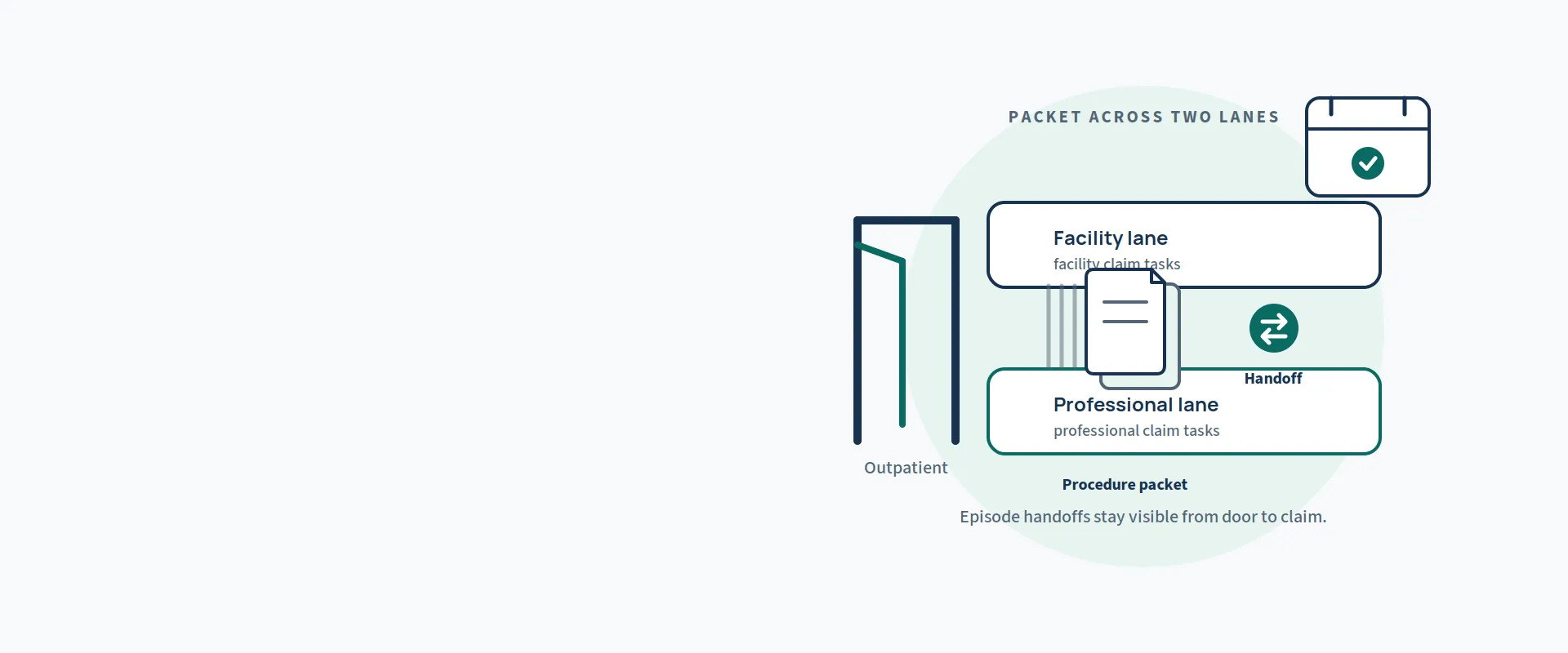
Ambulatory surgery billing services from Medical Billing Services Group (MBSG) keep surgery center claims clean — facility fees, professional claims, implant and device billing, and anesthesia coordination. We handle the split between what the center bills and what the surgeon bills, so neither side leaves revenue behind.
ASC denials eating your margins? Get a Free Billing Audit — we will review your facility and professional claims and pinpoint exactly where revenue is leaking.
Practice/setting fit
Our ambulatory surgery billing services fit independent ambulatory surgical centers, hospital-operated ASCs, single-specialty surgery centers (orthopedic, ophthalmology, GI, pain), and multi-specialty facilities. What makes ASC billing hard is the two-claim structure: every case generates a facility claim under ASC payment rules and a professional claim under the physician fee schedule — with different coding rules, different modifiers, and different denials — plus implant and device billing that follows its own pass-through logic.
We manage the full revenue cycle for these settings: benefits verification and prior authorization for scheduled cases, facility-fee coding under ASC rules, professional-fee coding for your surgeons, implant charge capture, daily claim submission, payment posting, and denial follow-up that goes back to the operative note. Our coding team codes both sides of every case, and our broader specialty billing programs cover your surgeons’ office work.
Documentation and coding risks
ASC billing fails most often when hospital outpatient habits are applied to ASC claims — the payment systems look similar but the rules differ. These are the rules we apply most often, each verified against a published CMS source.
ASC facility fees follow Chapter 14, not hospital OPPS rules
Medicare pays ASC facility services under the ASC payment system, and the billing and payment requirements are published in Chapter 14 of the Medicare Claims Processing Manual (Pub. 100-04) — not in the hospital outpatient (OPPS) chapter. Covered surgical procedures are paid from the ASC list with ASC rates and ASC-specific packaging rules; services outside the list are not payable as ASC facility services. A case coded correctly for a hospital outpatient department can still deny or misprice as an ASC claim. We code every case against the ASC list and Chapter 14 rules, and we keep the distinction sharp for centers that also hold hospital-based status.
Payer/program: Medicare (CMS) · Jurisdiction: United States (federal) · Source: “Medicare Claims Processing Manual, Pub. 100-04, Chapter 14 — Ambulatory Surgical Centers (billing and payment requirements for ASC facility services)” · Publication date: current chapter at cms.gov · Effective date: ongoing · Last reviewed: 2026-10-08
The professional fee and the facility fee are two separate claims
When surgery is performed in an ASC, the physician’s professional services are paid separately under the physician fee schedule — at the facility (non-office) rate, since the ASC bears the facility costs — while the center bills its own facility fee. These are two claims, two sets of coding rules, and two denial streams. The operative note must support both: the surgeon’s work for the professional claim and the resources used for the facility claim. Implanted devices add a third thread, with their own coding and payer-specific coverage rules. Our workflow builds both claims from the same operative note and reconciles them, so a device captured on the facility side is not missed on the professional side and vice versa.
Payer/program: Medicare (CMS) · Jurisdiction: United States (federal) · Source: “Medicare Benefit Policy Manual, §260.1 — Definition of Ambulatory Surgical Center (distinct entity; agreement with CMS; 42 CFR 416.25–416.49; professional services paid separately at the facility-adjusted rate)” · Publication date: Rev. 104, issued 2009 (definition; check current manual) · Effective date: ongoing · Last reviewed: 2026-10-08
Interrupted procedures and bilateral billing have ASC-specific handling
When a scheduled ASC procedure is discontinued, the facility claim uses modifiers 73 or 74 (rather than the professional modifier 53) to report the interrupted service — using the wrong modifier family is a clean denial. Bilateral procedures follow their own logic: modifier 50 rules, single-line billing, and Medically Unlikely Edits that limit units per day all interact, and the correct approach differs between the facility and professional claims. We apply the ASC-specific modifier rules on the facility side and the physician rules on the professional side, from the same operative note.
Payer/program: Medicare (CMS) · Jurisdiction: United States (federal) · Source: “Medicare Claims Processing Manual, Pub. 100-04, Chapter 14 — interrupted ASC procedures reported with modifiers 73/74 on the facility claim; bilateral billing per Chapter 14 guidance” · Publication date: current chapter at cms.gov · Effective date: ongoing · Last reviewed: 2026-10-08
Not sure your ASC coding would survive an audit? Get a Free Billing Audit — we will test a sample of facility and professional claims against the rules above and show you the gaps.
Payer and authorization checks
Medicare’s ASC rules above govern fee-for-service facility claims; commercial payers and Medicare Advantage plans contract with ASCs on their own fee schedules, with their own covered-procedure lists and prior authorization requirements. Carve-outs for implants and high-cost devices are common and vary by contract. We verify benefits and authorization before the case is scheduled, confirm implant coverage under the specific contract, and track authorizations to written determinations so a scheduled case does not become an uncovered one.
Workflow and reporting
ASC revenue lives in the operative note and the implant log, so our workflow starts with both. We reconcile the surgery schedule against completed operative notes, code the facility fee under Chapter 14 and the professional fee under physician rules, capture implants and devices, scrub both claim streams against payer-specific edits, submit daily, post payments, and work denials through our structured denial management process.
Reporting makes the pattern visible. Illustrative examples of what our reports show: a weekly denial snapshot grouped by root cause (authorization, coding, implant coverage, bundling) and by claim stream (facility vs. professional), days in AR by payer, and a clean-claim rate trend for your case lines. These are illustrative examples, not guarantees — results depend on payer mix, documentation quality, and case mix. But you will always see where revenue stands and what we are doing about it.
Onboarding and pricing factors
Onboarding starts with the free billing audit — a real review of recent claims, not a sales call. Implementation then covers payer enrollment and contract verification, clearinghouse and EHR connections, operative-note charge-capture mapping (including implants), and a coding review of your highest-volume procedures on both the facility and professional sides. Factors that shape a quote: monthly case and claim volume, single- versus multi-specialty mix, number of surgeons and anesthesiologists, payer and contract mix, and whether you need full revenue cycle or billing only.
We do not publish one-size-fits-all rates because they would be meaningless at this complexity. Your proposal will specify the pricing model, minimum fees, and turnaround for implementation, along with the credentials of the team assigned to your account. We serve surgery centers in all 50 states — call +1 (307) 396-4107 or email contact@medicalbillingservicesgroup.com, or review transparent pricing details.
FAQs and dated sources
Do you bill both the facility fee and the surgeon’s professional fee?
Yes. We build both claims from the same operative note — the facility fee under ASC payment rules and the professional fee under the physician fee schedule — and reconcile the two streams so implants, devices, and procedures are captured on the correct side.
Why do our ASC claims deny when the same case paid fine at the hospital?
Because the payment systems differ. ASC facility services follow Chapter 14 of the Claims Processing Manual with the ASC procedure list and ASC rates — hospital OPPS habits (code selection, modifiers, packaging assumptions) do not transfer cleanly.
How do you handle implant and device billing?
We capture implants from the operative note and implant log, code them per the payer’s rules, and verify coverage under each commercial contract’s carve-outs before the case — since implant coverage varies widely by contract.
Do Medicare ASC rules apply to our commercial contracts?
Not automatically. Commercial payers use their own ASC fee schedules, covered-procedure lists, and authorization requirements. We check each contract rather than assuming Medicare’s rules govern.
How do we start working with MBSG?
Start with a free billing audit — we review recent facility and professional claims across your case lines. Or contact our team directly to talk through your volume and payer mix.
Medical Billing Services Group — Medical Billing & Revenue Cycle Management. If ASC billing complexity is costing you cases’ worth of revenue, start with a Free Billing Audit and see exactly where your claims stand.
General educational information, not legal advice or a guarantee of reimbursement. Requirements vary by payer, plan, setting and date of service.
CPT is a registered trademark of the American Medical Association.