
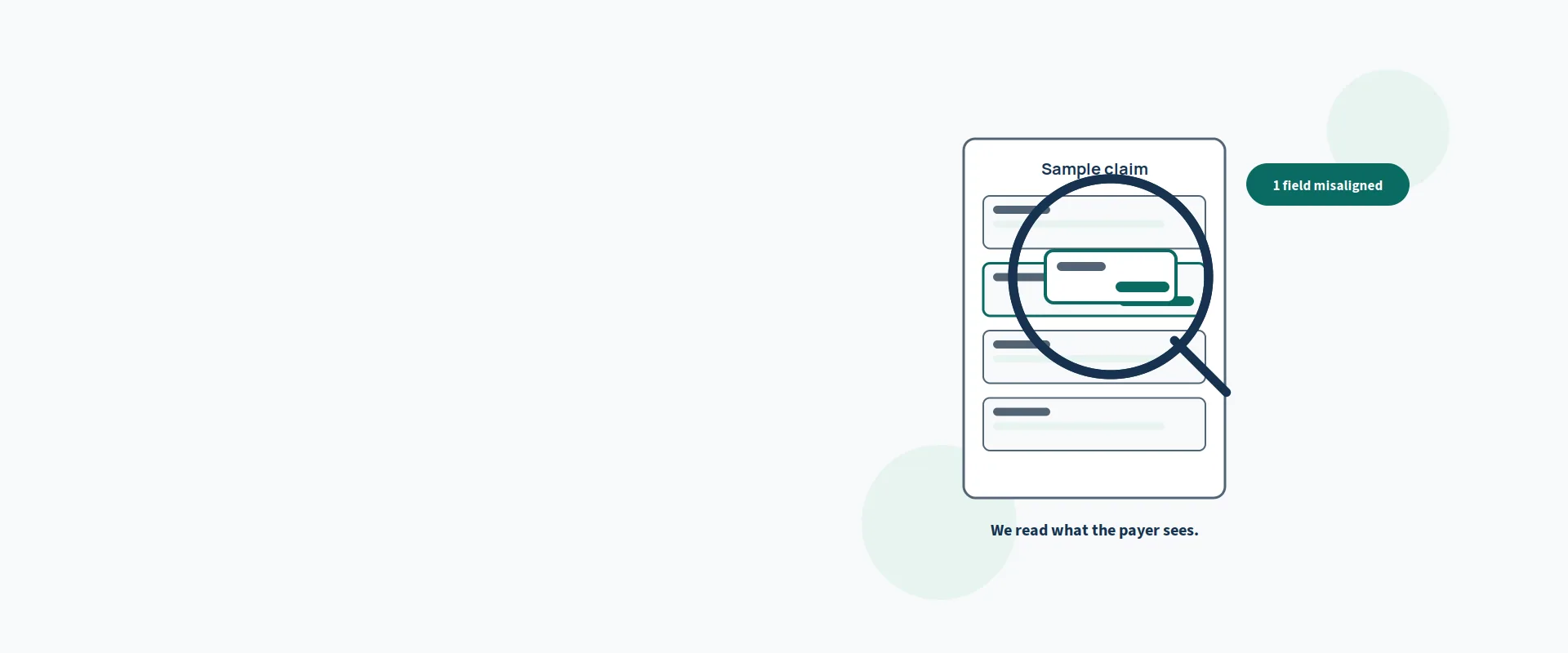
A medical billing audit examines claims, coding, and documentation against payer rules to find revenue leaks and compliance risk. Medical Billing Services Group (MBSG) offers a comprehensive audit service for practices that need an independent, evidence-based review of revenue cycle performance, delivered as a written findings report with severity-rated issues and concrete remediation steps.
Direct answer: MBSG’s medical billing audit service samples your recent claims, compares each claim against its source documentation, checks coding against NCCI and payer policies, and reports severity-rated findings with remediation steps. It suits practices preparing for growth, changing billing vendors, or responding to rising denials. Scope and turnaround are confirmed in your engagement letter.
Get a Free Billing Audit — start with our limited-scope free introductory assessment , then decide whether a full audit is warranted. Prefer to talk first? Contact us.
Scope and suitable buyers
This page describes the comprehensive audit service. It is different from the free billing audit, which is a limited-scope introductory assessment designed to identify whether a deeper review is likely to pay off. The free audit samples a small slice of claims and highlights surface-level patterns. The comprehensive service goes further: larger stratified samples, line-by-line coding audits, provider-side bill review, documentation adequacy review, and payer-policy compliance checks.
The comprehensive audit suits independent physician practices, specialty groups, ambulatory surgery centers, and behavioral health organizations asking concrete questions: are we coding what was documented, and only what was documented? Are payer edits and medical-necessity rules applied consistently? Where exactly are denials and underpayments originating? It also fits practices changing billing vendors or bringing billing in-house, by establishing a documented performance baseline. It does not replace legal counsel or a certified compliance review for fraud-and-abuse questions.
Workflow
Every audit follows the same documented methodology so findings are reproducible.
Inputs
We begin with access to the systems holding your billing truth: your practice management system or EHR for claim history and remittance data, documentation sources for sampled encounters, your payer mix and fee schedules, and existing coding and billing policies. Data transfer follows our standard HIPAA safeguards . You define which service lines, providers, or payer categories to include or exclude. If you use a clearinghouse or billing vendor, we set handoffs so the audit never disrupts operations.
Quality checks
Sample selection uses stratified random sampling across the agreed service lines and payers, documented so the sample is representative rather than cherry-picked. Each sampled claim is compared against its source documentation line by line: diagnoses supported by the record, procedures documented and captured, modifiers applied correctly, charges consistent with what was performed. Coding is checked against the CMS NCCI Medicare Policy Manual (CMS, current edition; last reviewed 2026-10-07), applicable payer medical policies for your service lines, and standard coding references for the date of service. A second reviewer validates a findings subset to confirm severity ratings.
Escalation and reporting
Issues affecting payment or compliance exposure are escalated to you as confirmed — not saved for the final report — so urgent problems such as a systematic modifier error on a high-volume code can be corrected mid-engagement. The audit closes with a findings report in your agreed format plus a walkthrough call. Findings are rated Critical (direct payment or compliance impact), Moderate (revenue loss or audit exposure), or Informational (process improvement), each with a recommendation, an owner, and a suggested timeline. An optional confirmation re-check verifies remediation took hold.
Included and excluded work
Included: stratified claim sampling and claim-to-documentation comparison; coding audits with NCCI and payer-policy checks; provider-side bill review (bills and statements generated on the provider’s side checked for accuracy and consistency with claims); documentation adequacy review against medical-necessity standards; denial and write-off pattern analysis on the sampled period; severity-rated findings report with remediation roadmap; leadership walkthrough.
Excluded: legal opinions and fraud-and-abuse determinations (refer to qualified counsel); clinical documentation improvement that rewrites provider notes (we recommend changes; we do not author clinical records); credentialing and payer enrollment (credentialing and payer enrollment); active denial appeals on current inventory (a separate service, though the audit identifies which appeal categories the data supports); IT, EHR configuration, or cybersecurity beyond data-transfer safeguards.
Onboarding and systems
Onboarding starts with a scoping call defining the audit period, service lines, payers, sample size, and exclusions, documented in an engagement letter. Data access runs through secure, audited channels consistent with our HIPAA security program. We work with records exported from your existing systems — no platform change required. The engagement is remote unless you request otherwise.
Pricing factors
Audit pricing reflects the work involved: number of claims sampled and whether sampling spans multiple service lines or specialties; number of payers and how many publish distinct medical policies for your codes; whether documentation must be gathered from multiple systems or locations; and whether you add the optional remediation re-check. Pricing model and minimum fees are quoted after scoping; see medical billing pricing for engagement structure.
Verified evidence
Coding accuracy checks reference the CMS National Correct Coding Initiative (NCCI) Medicare Policy Manual (CMS, current edition; last reviewed 2026-10-07). Payer-policy checks cite the specific published policy and effective date in each finding. Sampling methodology and severity definitions are documented in your engagement letter before fieldwork. We cannot verify in advance what a finding represents in revenue until the sample is drawn — impact is estimated only after measurement. General educational information, not legal advice or a guarantee of reimbursement. Requirements vary by payer, plan, setting and date of service.
Illustrative sample: annotated findings report (format example)
The following describes the structure of an audit findings report. It is an illustrative sample of the report format only — it contains no client data, no real claims, and no measured results.
Check categories: (1) claim-to-documentation alignment; (2) diagnosis coding accuracy and support; (3) procedure and charge capture completeness; (4) modifier usage; (5) NCCI edit compliance; (6) medical-necessity documentation adequacy; (7) payer-policy alignment; (8) timely filing and charge-entry lag.
Finding format: Finding ID (e.g., “AUD-014”), category, sampled claim reference (e.g., “Sample claim 014 of 200”), the observation in plain language, a severity rating of Critical, Moderate, or Informational per the engagement-letter definitions, and a recommendation naming the responsible owner with a suggested completion window. A summary table rolls findings up by category and severity; an appendix lists every sampled claim with a pass/flag disposition.
Get a Free Billing Audit to see whether your claim patterns warrant a full audit — or talk to us about scoping a comprehensive engagement.
FAQs
How is the comprehensive medical billing audit different from the free billing audit?
The free audit is a limited-scope introductory assessment that flags whether deeper problems are likely. The comprehensive service samples more claims across more categories, performs line-by-line coding audits, reviews documentation and provider-side bills, checks payer-policy compliance, and delivers a severity-rated findings report with a remediation roadmap.
How long does a medical billing audit take?
Turnaround depends on sample size, payers, service lines, and documentation availability. The timeline is confirmed in your engagement letter, and urgent findings are escalated as confirmed rather than held for the final report.
Will the audit disrupt daily billing operations?
No. Data is pulled from your existing systems on an agreed schedule, the engagement is remote, and handoffs are defined up front so sampling never competes with daily claim submission.
Does the audit include documentation review, or just claim data?
Both. Coding audits compare each sampled claim against its source documentation, and documentation adequacy is reviewed against medical-necessity standards.
What do we receive at the end?
A written findings report with severity-rated findings, recommendations with owners and timelines, a category-level leadership summary, and a walkthrough call. An optional remediation re-check verifies corrective actions worked.
Is the audit confidential?
Findings go to your practice only, handled under our HIPAA safeguards and business associate agreement. We do not report results to payers or regulators; any voluntary disclosures are your decision with your counsel.
Get a Free Billing Audit — the fastest way to learn whether a comprehensive medical billing audit would pay for itself. Our medical billing services hub shows how audits fit into revenue cycle management and billing consulting.